
This site is also available on:
 Deutsch
Inhaltsverzeichnis
Contribution to the expansion of wind energy in Germany
Air traffic control in Germany faces the challenge of combining modern technologies with the increasing expansion of renewable energies. Wind turbines, in particular, which are often erected in exposed locations such as hilltops or other elevated areas, can interfere with the operation of traditional radio navigation systems. Given the growing importance of wind energy, a significant step towards modernizing the navigation infrastructure was taken in a joint project with the Federal Ministry for Economic Affairs and Energy (BMWi). Deutsche Flugsicherung GmbH (DFS) replaced four older CVOR radio navigation systems with more robust and less interference-prone DVOR systems. This project makes a substantial contribution to ensuring a balance between safe air traffic and sustainable energy production.
Air traffic control facilities and their importance
Air traffic control systems play a central role in aviation. They serve for communication, navigation, and the tracking of aircraft, ensuring safe and efficient air traffic. Radio navigation systems, especially VOR (VHF Omni-Directional Range) stations, are essential ground stations that provide aircraft with precise directional information via radio signals. This enables pilots to orient themselves and navigate even in poor visibility or on sections of the route without visual references.
Conventional VOR systems are widely available in two variants: Conventional VOR (CVOR) and Doppler VOR (DVOR). While CVOR systems are essentially older technology, DVOR systems are characterized by higher immunity to interference, particularly from external sources such as wind turbines. Therefore, in aviation navigation, it is essential to use modern and reliable systems that can meet current challenges.
Challenges posed by wind turbines
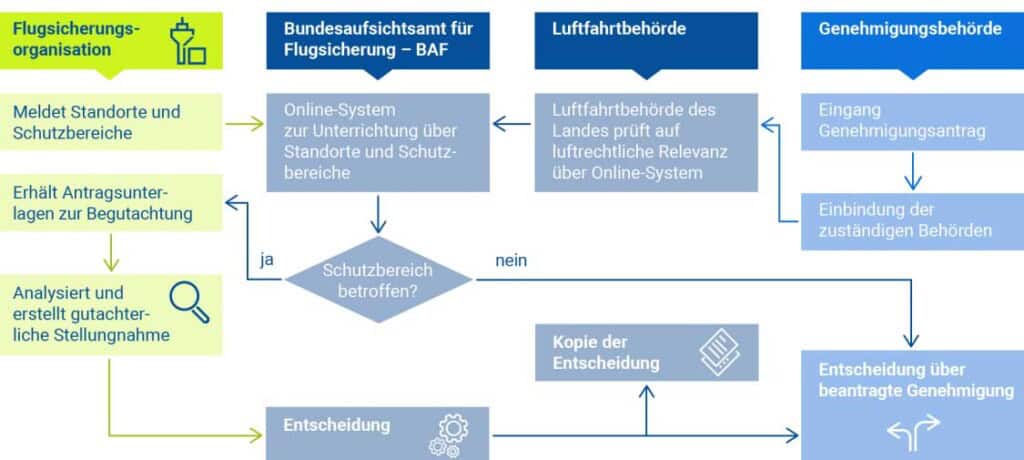
Wind turbines benefit from similar location advantages as air traffic control facilities. Higher elevations and open areas offer ideal conditions for energy generation through wind power. However, these locations can lead to mutual interference: VHF omnidirectional range (VOR) beacons or other navigation systems are electromagnetically affected by the moving parts of wind turbines, which can impair the accuracy and reliability of navigation information.
Interference from wind turbines poses not only a technical but also an operational risk. Malfunctions or uncertainties in aircraft positioning can lead to safety risks in air traffic. Therefore, it is crucial to equip our navigation systems to be resistant to such interference.
Implementation of the modernization project
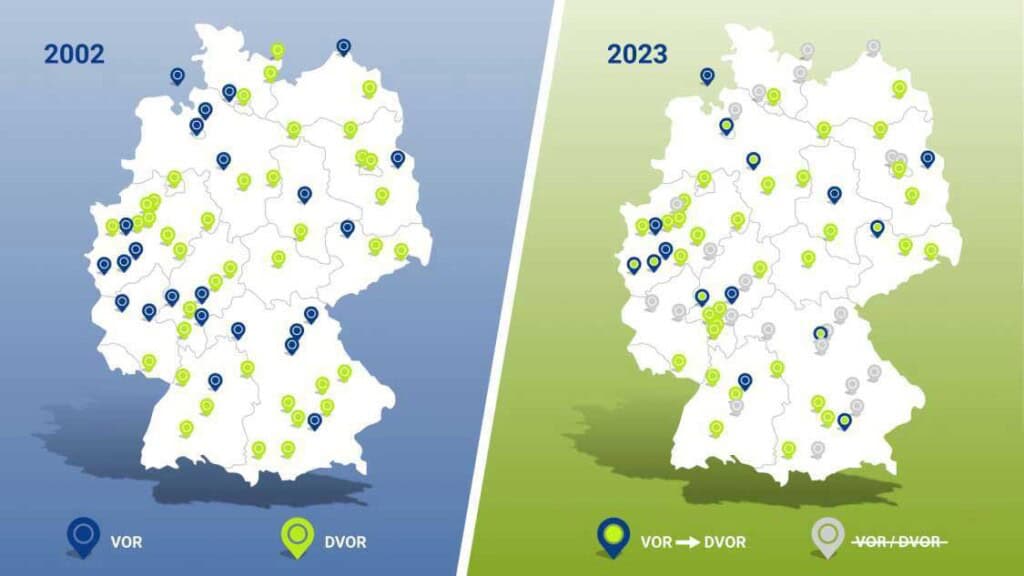
The Federal Ministry for Economic Affairs and Energy supported the modernization of radio navigation systems as part of a specific program implemented from mid-2021 to the end of 2025. DFS replaced the four existing CVOR systems at the Nuremberg, Cologne/Bonn, Düsseldorf, and Nienburg sites with improved DVOR navigation systems. These DVOR systems offer enhanced protection against interference from wind turbines, thus ensuring greater reliability and stability in navigation.
Simultaneously, the original VOR components at the Frankfurt am Main, Rügen, and Magdeburg sites were deactivated without requiring a conversion to DVOR. The DME (Distance Measuring Equipment) systems, which are less prone to failure and complement the navigation infrastructure, remain in operation there. This combination of different navigation components reflects a strategic approach that balances technical efficiency and operational safety.
These facilities are scheduled to be decommissioned in the coming years:
CVOR:
- Luburg (under review)
- Fürstenwalde (2025)
- Magdeburg (2025)
Technical fundamentals of CVOR and DVOR systems
Conventional VOR systems operate with a static transmission system that emits signals in various directions. The aircraft receives these signals and determines its direction to the transmitter based on the phase shift. However, CVOR systems are susceptible to interference, especially from nearby metallic or moving objects, such as wind turbines.
In contrast, the Doppler VOR principle uses a combination of stationary and moving transmitter antennas that induce a Doppler shift. This method significantly reduces signal interference and enables more precise direction finding. Because of these characteristics, DVOR technology offers a significant advancement in aviation navigation, particularly in environments with potential electromagnetic interference.
Advantages and effects of the conversion
The conversion to DVOR systems brings a number of advantages for air traffic and the wind energy industry. Firstly, it increases air traffic safety, as navigation systems are now more robust against external interference. Pilots can rely on dependable navigation information, which facilitates flight operations, especially at night or in poor visibility conditions.
Secondly, modernization promotes the acceptance and expansion of wind energy in Germany. By making navigation systems less prone to malfunctions, new wind power projects can be implemented at locations that were previously restricted for safety reasons. This supports the energy transition and contributes to security of supply through renewable energies.
Thirdly, the project demonstrates successful cooperation between government agencies, the energy sector, and security authorities. Funding by the Federal Ministry for Economic Affairs and Energy (BMWi) and implementation by DFS show how technological innovation and sustainable development can go hand in hand.
Outlook and future developments
The modernization of navigation systems exemplifies the infrastructure challenges of the energy transition era. Future developments in aviation navigation will continue to focus on digitalization, automation, and improved resilience to environmental influences. Continuous innovation is essential to meet the safety requirements of air traffic and support environmental goals.
Furthermore, the integration of additional technologies, such as satellite-based navigation systems or combined methods, is conceivable to make navigation even more precise and less susceptible to interference. Cooperation between different sectors will continue to be crucial in this regard.
Conclusion: A combination of technological innovation and sustainable energy policy
The deliberate modernization of radio navigation systems in Germany is an important step towards ensuring safe and efficient air traffic despite the expanding wind farms at exposed locations. Replacing outdated CVOR systems with more advanced DVOR technology has significantly reduced interference from wind turbines.
This measure strengthens both flight safety and the expansion of renewable energies, and is therefore a prime example of the successful combination of technological innovation and sustainable energy policy. The ongoing modernization of the navigation infrastructure will maintain a high level of safety in aviation while simultaneously creating space for a greener future.
The harmonious integration of navigation technology and wind energy represents a key task for the coming years. The experience gained from this project provides a valuable basis for further technical adjustments and enables German airspace to be made fit for the challenges of the future.
More about rotating radio beacons

DFS upgrades Nienburg CVOR to a DVOR
To make the Nienburg CVOR near Stöckse more robust against interference from wind turbines, DFS Deutsche Flugsicherung GmbH is upgrading the system to a…

Air traffic control reduces the protection zones of its VOR beacons
Since August 1, 2022, DFS Deutsche Flugsicherung GmbH has been reducing the size of its protected areas around radio beacons. This creates further potential for more areas.

Doppler VHF omnidirectional radio bea (DVOR) Sarstedt in operation
The new Sarstedt Doppler VOR (DVOR) between Hildesheim and Hanover has commenced operation. With this system, DFS Deutsche Flugsicherung (German Air Navigation Services) replaces the previous DVOR Leine system.
This might interest you:
 Air Astana sets standards: Parallel C-checks for Airbus A320 aircraft
Weitere NEWS:

UFO calls on Lufthansa CityLine cabin crew to stage a warning strike (10.02.2026)

KLM and SkyNRG are building the first SAF facility in the Netherlands (14.02.2026)

Eurofighter Typhoon with Aerodynamic Modification Kit (08.02.2026)

Engine problem on a Turkish Airlines A330: Emergency landing in Kolkata (09.02.2026)


DRF Luftrettung strengthens air rescue in Berlin with three stations (11.02.2026)