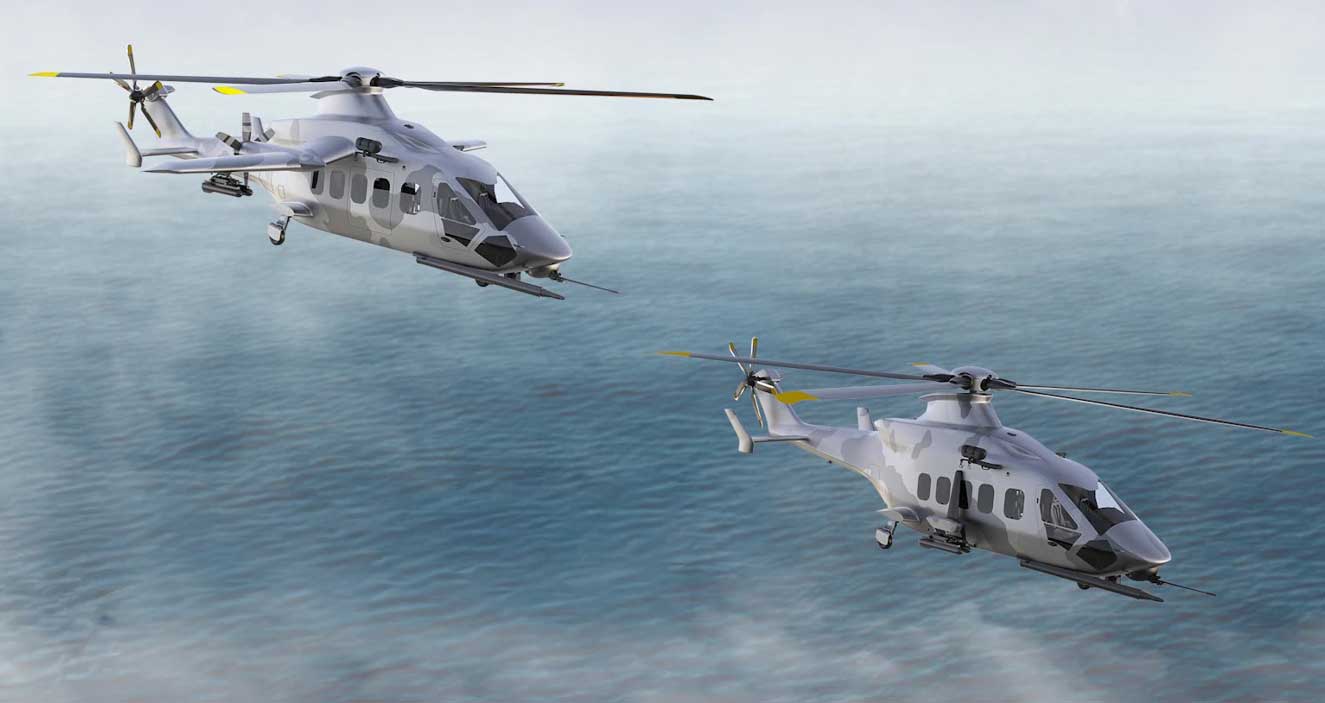
Concepts for next-generation rotor aircraft
The further development of military helicopter technology is at the heart of Airbus Helicopters’ latest initiatives, which have now unveiled their innovative concepts for next-generation rotorcraft. These developments are specifically tailored to NATO’s requirements within the framework of the Next Generation Rotorcraft Capabilities (NGRC) program. The goal is to provide high-performance, versatile, and economical rotorcraft that will significantly enhance the military firepower and flexibility of partner nations. At the center of these initiatives are two distinct but complementary aircraft systems: a conventional, high-performance helicopter and a novel high-speed combination aircraft that integrates innovative technologies for increased speed and efficiency. These approaches are based on the principles of high modularity and ease of handling, which should significantly simplify manufacturing, maintenance, and future development.
Advanced concepts for NATO capabilities
As part of the NATO study, Airbus is pursuing a dual-layered approach that addresses the needs of both conventional and modern, high-speed aircraft. Cooperation with strategic partners such as Collins Aerospace, Raytheon, and MBDA ensures the integration of state-of-the-art avionics, weapons technology, and communication solutions. The close integration of the two proposed concepts enables a high degree of shared components in maintenance, training, and system operations, contributing to the optimization of the overall system. Fundamental to this is the “Modular Open System Architecture,” an open and modular architecture that guarantees flexibility and adaptability throughout the entire lifecycle and across various operational scenarios. This plays a crucial role in keeping long-term costs low and enabling rapid modernization without requiring the complete replacement of existing platforms.
Conventional helicopter models are based on proven concepts and offer a balanced combination of accessibility, payload, and ease of maintenance. In contrast, the innovative high-speed rotor combines aerodynamic improvements with additional propulsion elements such as propellers and wings, significantly increasing top speed and maneuverability while simultaneously ensuring high fuel efficiency. Experience from previous developments, particularly with the X3 and Racer demonstrators, confirms the practicality of these advanced technologies and supports their use in the military sector.
Technical innovations and development strategy
Airbus Helicopters leverages its decades of expertise in developing both conventional and experimental rotary-wing aircraft and invests strategically in future-oriented technologies. A key focus is the integration of digital systems to improve connectivity and cybersecurity, as well as enabling cooperative command and control systems that effectively network manned and unmanned platforms. These so-called crewed-uncrewed teaming technologies open up new tactical possibilities and significantly enhance operational safety.
Furthermore, development focuses on improving survivability under combat conditions and on technologies for the rapid repair of damage in combat. This ensures significantly higher operational readiness and reduces downtime, which is of paramount importance, especially for demanding military operations. Combined with the modularity of the system architecture, Airbus is thus creating a flexible platform that can be adapted to different operational profiles and changing security situations. The preliminary studies and flight tests of the high-speed concept models also provide valuable data for the continuous optimization of the interaction of the various systems, as well as their performance and efficiency.
Cooperation with NATO and future prospects
The contractual agreement between NATO Support and Procurement Agency (NSPA) and Airbus Helicopters underscores the importance of this technological development for the entire Alliance. Under the NGRC project, Airbus will play a leading role in the design, development, delivery, and support of a medium multi-purpose helicopter. This commitment reinforces the goal of not only providing alliance partners with advanced aircraft but also maintaining a broad industrial base that fosters innovation and standardization in a multinational environment.
This is crucial to meeting the operational requirements of NATO member states in the 21st century and securing a sustainable technological leadership position in Europe and internationally. Alongside the ongoing evolution of models already in service, such as the NH90 and the H-series (H145M, H160M, and H225M), Airbus is working intensively on the next generation of products. This will offer improved cost-effectiveness, enhanced connectivity, and simpler maintenance, thus setting new standards in military aviation.
Conclusion: Combining conventional helicopters and high-speed rotorcraft
The unveiling of Airbus’s new helicopter concepts marks a significant step in the evolution of military rotorcraft, designed to better meet the demands of current and future battlefields. With a focus on modularity, simplicity, and cutting-edge technological innovation, the company offers a promising path to providing NATO members with high-performance, flexible, and economically viable platforms. The combination of conventional helicopters and high-speed rotorcraft significantly expands their operational capabilities.
Cooperation with leading suppliers and NATO partners creates a solid foundation for jointly addressing not only technical, but also strategic and logistical challenges. Overall, with these concepts, Airbus demonstrates its ability and willingness to lead the military helicopter fleet into a new era characterized by digitalization, networking, and enhanced combat capabilities. The commitment to research, development, and international collaboration guarantees a high-performance basis for future requirements for military engines and ram systems.
More about Airbus Helicopters
Airbus Helicopters: Increase in helicopter orders in 2025
Overview of market developments at Airbus Helicopters 2025 – Key customer orders and product diversity – Technological innovation and new product developments – Progress on the H160 program and expansion of application profiles – Expansion of global production capacities
Airbus Helicopters concludes 118 agreements at VERTICON
Airbus Helicopters concludes the VERTICON with a total of 118 customer agreements, including 63 firm orders for various multi-mission helicopters. A major focus was on the H140,…
Airbus Helicopters presents H140 at VERTICON
At VERTICON in Dallas, Airbus Helicopters unveiled its latest model, the H140, which sets new standards in the light twin-engine category. This multi-purpose helicopter…