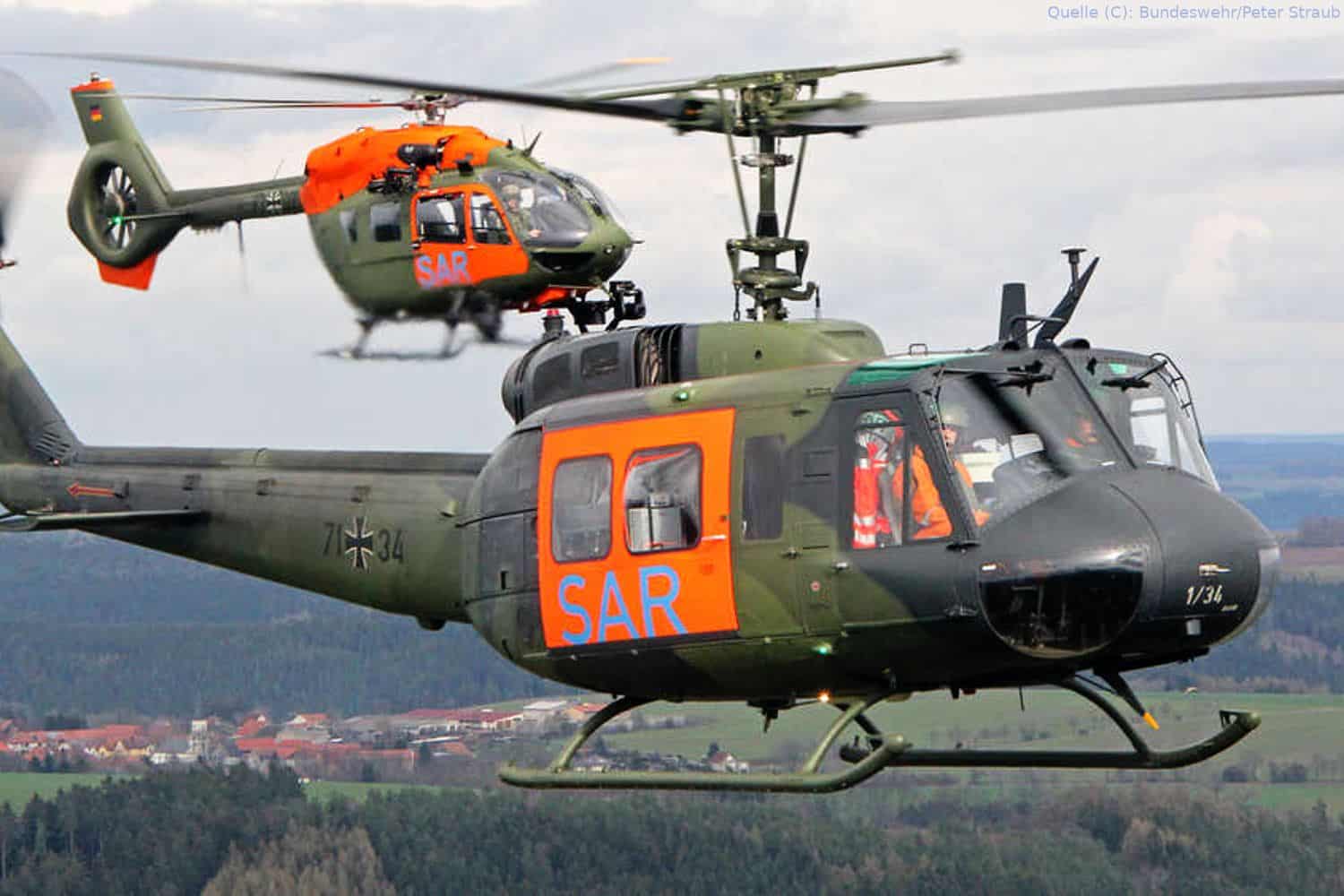
For nearly 50 years, the “Huey” was always there when needed. But now, the Bell UH-1D helicopter has finally been replaced by the Airbus H145.
For nearly half a century, the distinctive sound of the Bundeswehr’s Bell UH-1D rescue helicopter – also known as the “carpet beater” – could be heard in the sky. Starting in 1968, the Bundeswehr gradually acquired 340 of these UH-1D aircraft. The helicopters were deployed for personnel transport, fighting forest fires and floods, and search-and-rescue operations. For years, they were operated by the German Air Force.
On April 12, in the presence of Defense Minister Annegret Kramp-Karrenbauer, the last of the three SAR detachments in Holzdorf transitioned to the new, state-of-the-art successor aircraft.
The German Army has been responsible for the Search and Rescue (SAR) mission since 2013. In December 2018, the H145 LUH SAR – manufactured by the Donauwörth-based company Airbus – was selected to replace the “Huey,” with the first helicopter delivered just a year later. Due to the coronavirus pandemic, the replacement of the UH-1D took place on Monday on a very small scale and under strict conditions.
Is it possible to buy retired Bundeswehr Bell UH-1D helicopters?
In principle, it is possible to purchase retired Bundeswehr Bell UH-1D helicopters (also known as “Hueys”), though not as airworthy aircraft directly from the state, as military equipment is demilitarized beforehand.
An overview of procurement and the current market:
- Sales via VEBEG: The Bundeswehr sells decommissioned equipment (including aircraft and spare parts) through tenders managed by the federally owned company VEBEG. Please note that VEBEG’s FAQs state that sales to private individuals are excluded; purchasers must be business entities.
- Non-airworthy machines: The helicopters are usually demilitarized and sold without engines or sensitive avionics. Such airframes often serve as sources of spare parts, museum pieces, or for civilian scale modeling.
- Used market: Complete or restored machines can occasionally be found through specialized aircraft brokers (such as AirSPS) or dealers in military antiques (such as Morlock Motors).
All pilots are trained
Colonel Andreas Springer, the senior officer at the base, and Colonel Peter Göhringer – commander of Transport Helicopter Regiment 30, which is stationed in Niederstetten (Baden-Württemberg) and tasked with the continuous SAR (land) mission – jointly welcomed Defense Minister Kramp-Karrenbauer to the Holzdorf SAR command. Despite the sense of nostalgia surrounding the retirement of the legendary UH-1D, the Minister described the transition to the new weapon system as a positive day for the Bundeswehr’s search and rescue service. It marked the disappearance of a Bundeswehr icon that had been a familiar sight and sound for over 50 years. “We are bidding farewell to a legend today,” the Minister said. However, the Airbus Helicopters H145 is a worthy successor.
Brigadier General Andreas Pfeifer, Deputy Commander of the Rapid Forces Division, emphasized the high level of motivation and professionalism of the participating units, noting that their perfect cooperation had ensured the project’s success.
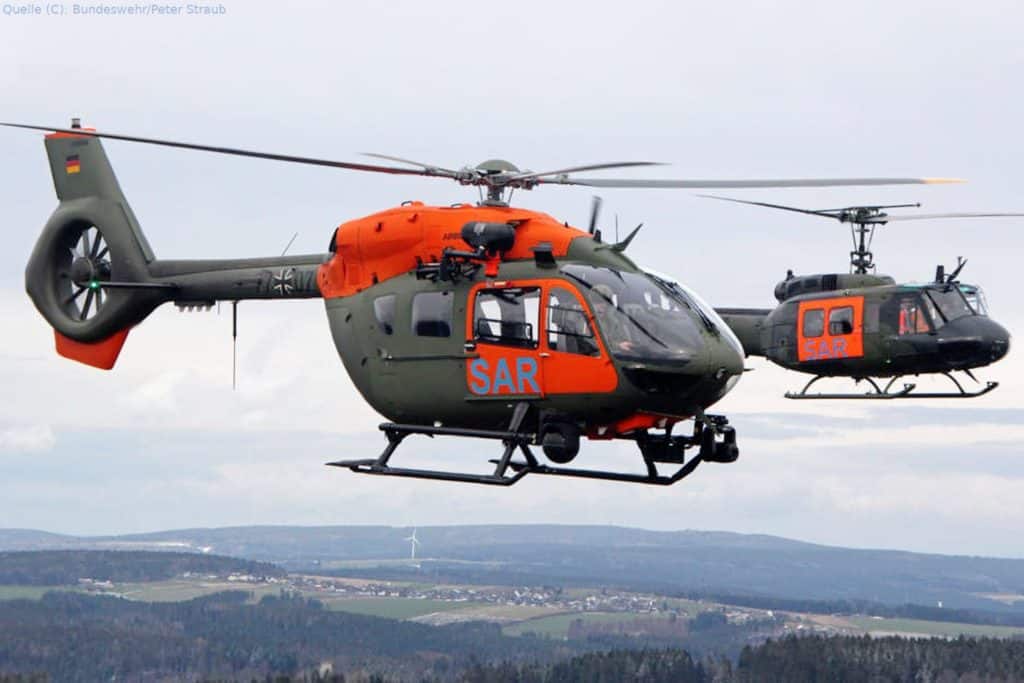
By now, all seven ordered H145s have been handed over to the Army, and the training of all 51 pilots was completed before Christmas of last year. During a high-profile event attended by the Inspector of the Army, the first transition of the weapon system from the UH-1D to the H145 was ceremonially marked on July 6 at the SAR (L) unit in Niederstetten, followed by the transition at Nörvenich on December 7.
The “open-heart surgery” – that is, the transition to a new weapon system while simultaneously maintaining operational readiness at all three SAR(L) detachments – has successfully cleared another major hurdle. However, Göhringer does not yet consider the transition complete. His focus for 2021 is on further professionalizing the aircrews and expanding capabilities in mountain flying.
“Goodbye Huey Tour” with special livery
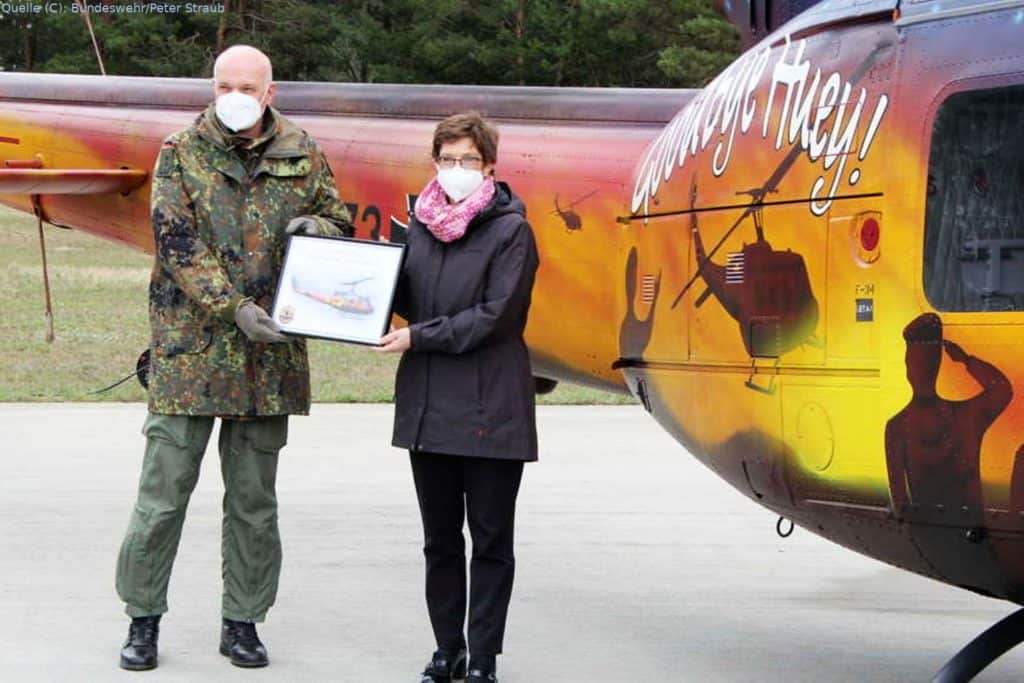
The Bell UH-1D will remain a familiar sight in the skies over Germany until the end of June 2021. To mark its retirement, one helicopter was given a special livery, which was also on display during the Minister’s visit. As part of a “Goodbye Huey Tour,” the “carpet beater” – as the aircraft is nicknamed – will bid farewell from selected airfields across Germany, provided COVID-19 pandemic restrictions allow. Afterward, the “Goodbye Huey” will be on permanent display solely at the Helicopter Museum in Bückeburg. Incidentally, the name “Huey” is derived from the original model designation, HU-1.
SAR in three commands
As a member of the International Civil Aviation Organization (ICAO), the Federal Republic of Germany is committed to conducting search and rescue operations for missing or crashed aircraft within its territory – a task that would normally fall to the Federal Ministry of Transport. Lacking its own aircraft for this purpose, the task is performed by the Bundeswehr, with the Navy monitoring maritime and coastal areas. Commissioned by the Army, Transport Helicopter Regiment 30 operates three SAR detachments: Niederstetten (Baden-Württemberg), Holzdorf (Brandenburg), and Nörvenich.
All Bundeswehr rescue helicopters are alerted by the Rescue Coordination Center (RCC) in Münster, which is also linked to civilian dispatch centers. In addition to their search and rescue duties, these SAR helicopters are available 24 hours a day, 365 days a year, for situations where civilian rescue helicopters are unavailable or lack the necessary technical equipment (such as a rescue hoist).
State-of-the-art medical equipment
The new SAR (Search and Rescue) aircraft are equipped for medical operations just like civilian air ambulances. However, they also feature state-of-the-art search avionics, such as thermal imaging systems and mobile phone tracking capabilities. In addition, they are equipped with various communication systems, day/night vision cameras, searchlights, a rescue hoist, and an external cargo hook – for instance, for use with fire-fighting buckets. Unlike civilian air ambulances, the Bundeswehr’s SAR helicopters are available for operations at night; consequently, the crew consists of two pilots and an air rescue specialist trained as an emergency paramedic.