Overview of developments in air traffic at Fraport
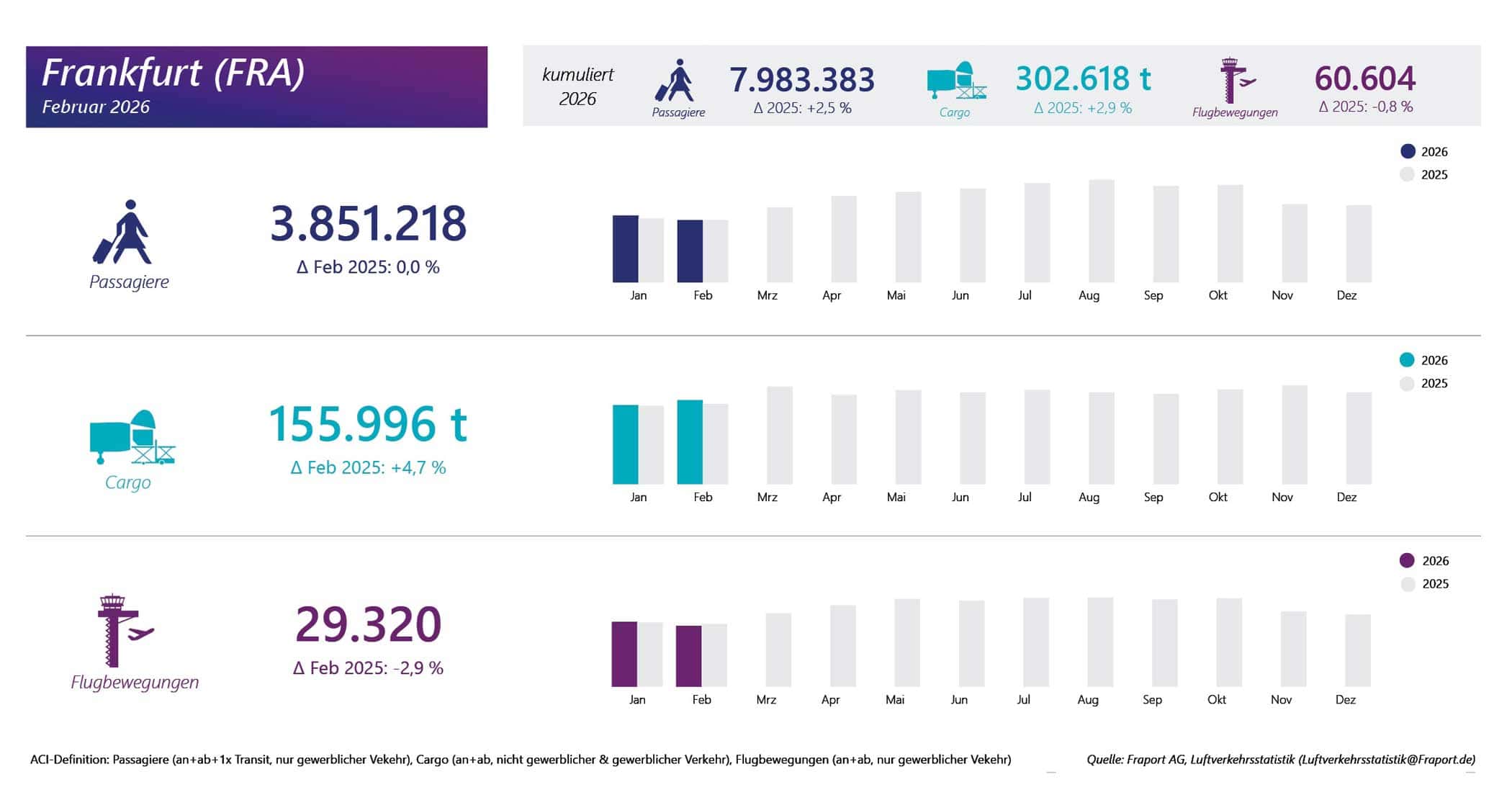
February marked an important milestone for Frankfurt Airport in terms of passenger numbers, which remained stable at 3.9 million passengers compared to the previous year. Despite challenges such as weather-related and strike-related flight cancellations, which affected approximately 70,000 passengers, the airport maintained its position as a major hub in international air traffic. This development demonstrates the airport’s high level of operational stability even under adverse conditions, which is of great importance both for the airport itself and for the stakeholders in the industry.
Changes in the cargo sector also contributed to the overall performance, with volume increasing by 4.8 percent to over 159,000 tons. This demonstrates that, in addition to passenger traffic, cargo handling plays a vital role for the airport. However, the number of aircraft movements declined slightly, suggesting increasingly efficient capacity utilization and potentially a change in the flight schedule.
Passenger growth in Frankfurt and its global significance
Frankfurt Airport has established itself over decades as one of the most important international air traffic hubs. With 3.9 million passengers served in February, passenger numbers remained at a comparable level to the previous year. Its role as a central hub means that Frankfurt Airport plays a significant role not only for the region but also for international traffic. The stability it maintains despite external disruptions such as strikes or adverse weather conditions underscores the high efficiency of its infrastructure and operational processes.
Furthermore, the figures reflect the vulnerability of air traffic to such disruptions, with approximately 70,000 passengers directly affected. This clearly demonstrates how weather and labor disputes can impact travel and the importance of resilient planning and response mechanisms for all involved. Moreover, these factors can have indirect effects on the profitability of airlines and airports, leading to delays, rebookings, and additional costs.
International airports in the Fraport Group’s portfolio
While Frankfurt Airport experienced stable development, the Group’s international portfolio as a whole showed strong growth. Ljubljana Airport in Slovenia deserves special mention, having recorded a passenger increase of over 17 percent compared to the previous year. This strong growth underscores the increasing importance of this location for the region and the Fraport Group as a whole.
In Brazil, the airports in Fortaleza and Porto Alegre also recorded a remarkable increase of almost 15 percent, with over one million passengers. This growth indicates rising mobility in South America and the expansion of Fraport’s global reach. Similarly, Lima Airport in the Peruvian capital saw growth of more than 4 percent, suggesting potentially increasing tourist numbers and rising business travel.
In Greece, the 14 airports operated by Fraport also performed well, handling over 700,000 passengers in the reporting month, with an increase of approximately 9 percent. These figures reflect the attractiveness of Greek holiday regions and the ongoing liberalization of aviation markets. The Twin Star airports of Burgas and Varna in Bulgaria even recorded growth of over 11 percent, highlighting the increasing importance of Eastern Europe as a travel destination.
On the other hand, the Antalya location in Turkey experienced a decline in passenger numbers of almost 4 percent, which could be attributed to political or economic factors or simply reflect seasonal fluctuations. These differences in passenger numbers within the international portfolio illustrate the complexity of global air traffic developments and the need for a diversified strategy.
Fraport Cargo Volume and Aircraft Movements: Efficiency and Challenges
The 4.8 percent growth in cargo volume to more than 159,000 tons demonstrates that Frankfurt Airport and Fraport’s network are strengthening their importance as logistics hubs. The increasing demand for air freight is closely linked to global trade, and especially e-commerce, which requires fast delivery times. This makes cargo capacity a crucial success factor.
The slight reduction in flight movements by just under 3 percent can be interpreted as a sign of optimized processes or a change in flight planning. The increase in average maximum takeoff weights, which reached almost 1.9 million tons despite a slight decrease compared to the previous year, likely plays a role here. This suggests that aircraft may be operating at higher capacity and transporting larger quantities of passengers or cargo, a situation facilitated by modern fleets and more efficient deployment plans.
Overall, it is clear that the balance between stable passenger numbers and a growing cargo segment is essential for the growth and competitiveness of airports. However, challenges such as strikes and extreme weather events constantly demand a high degree of flexibility and adaptability.
Outlook and conclusion
The total figures of around 8.7 million passengers at the airports operated by Fraport in February, with an increase of over 3 percent compared to the same period last year, illustrate the positive trend in global air traffic, despite some differential developments at locations such as Antalya.
The interplay of stable passenger numbers in Frankfurt, rising figures in international markets, and growing cargo capacities illustrates the diverse role Fraport plays in international aviation. The ability to respond quickly to challenges while simultaneously leveraging growth potential in emerging markets forms the basis for the company’s future positioning.
In conclusion, it should be noted that Frankfurt Airport has maintained its position as a central hub despite adverse factors, and that Fraport’s global portfolio, with its diversified locations and diverse market opportunities, enables more robust development than isolated sites. This promises stability and growth for the future, provided that the evolving demands of the aviation industry can continue to be met effectively.
More about Fraport