
Fees and location costs reduce seating capacity.
Germany’s aviation sector is experiencing a setback in the first half of 2026. Despite rising global flight volumes and improving travel activity, Germany is once again seeing a decline in passenger numbers – a trend that calls into question the sector’s economic significance and points to serious structural challenges. In addition to global factors such as geopolitical tensions and regional labor disputes, high location-related costs and a burdensome aviation tax are weighing heavily on the sector’s performance.
The negative trend demonstrates how closely the competitiveness of German air transport is linked to the political framework and economic infrastructure. The impact extends beyond airlines and airports, with far-reaching consequences for mobility, trade, and industry across the country.
Current situation and reasons for declining passenger numbers
While air travel is recovering in the wake of the pandemic across many European countries and internationally, Germany is lagging significantly behind this upturn. Passenger numbers at German airports fell to 97.7 million in the first half of 2026 – just under one percent below the figure for the same period the previous year. This negative half-year result indicates that Germany’s competitiveness as an aviation hub is suffering, despite rising global mobility and worldwide economic momentum driven by various factors.
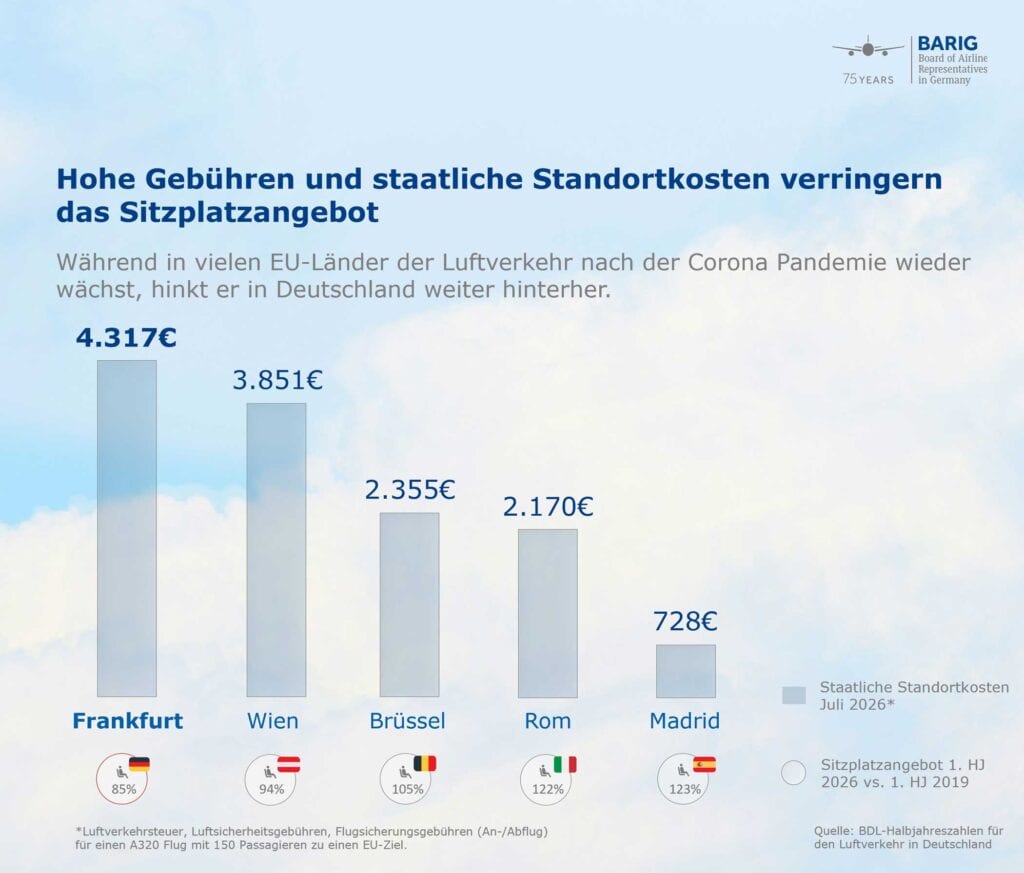
In addition to the burdens caused by the Middle East crisis and recurring industrial action, the enormous cost structures imposed by the state stand out as a primary drag on the sector. High airport charges, increased security costs, complex regulatory requirements, and – not least – the aviation tax are prompting airlines to increasingly avoid the location or shift capacity abroad. This impairs connectivity – specifically international links – and significantly restricts the range of services offered.
The reduction in flight connections and the number of airports has direct consequences in particular: passengers face higher ticket prices and a more limited choice of destinations, while business travelers and tourists increasingly seek alternative routes via foreign airports. This lastingly undermines the competitive position of German airports and airlines.
Location costs: Consequences for the economy, mobility, and the environment
Reduced flight activity poses a challenge not only for passenger transport but also affects freight transport and the entire economic supply chain. Air freight is a crucial component for the rapid and flexible flow of goods – particularly in the high-tech, mechanical engineering, and pharmaceutical sectors, where Germany is a global leader. Shifting logistics routes abroad results in higher costs and longer transit times. For the industrial sector, this translates into a competitive disadvantage vis-à-vis international rivals.
Furthermore, poor connectivity and reduced capacity force companies to resort to more environmentally damaging alternatives, such as road freight transport. This leads not only to an increase in road traffic but also to higher CO2 emissions and greater pollution. The result is a conflict of objectives: while sustainability and climate protection are becoming increasingly important in the aviation sector, the current situation in Germany causes these goals to be disregarded for economic reasons.
Coupled with rising ticket prices, the passenger travel experience is deteriorating, leading to a stronger preference for flight connections from airports abroad – a trend that further weakens the competitive position of German airports. Infrastructure investments are stalling, which diminishes the long-term attractiveness of German aviation hubs.
Recommendations for action and political responsibility
Against the backdrop of the ongoing negative trend, the aviation industry is calling on the Federal Government to take decisive and sustainable action. The central demand is to significantly lower cost structures at German locations in order to restore competitiveness. Abolishing the air traffic tax represents a particularly effective lever; the minimal reduction implemented for the summer season is viewed as insufficient and fails to provide any significant stimulus to the market.
In addition, supporting measures are required: these include simplifying regulatory processes, investing in modern and efficient airport infrastructure, and providing greater support for innovative technologies and sustainable concepts in order to both reduce environmental impact and enhance competitiveness vis-à-vis neighboring European countries.
Such measures serve not only to stabilize air traffic and the airlines themselves but are also of paramount importance to Germany as a business location. Jobs in the aviation sector, in trade, and in related industries depend directly on efficient and affordable air travel. Furthermore, air transport plays a key role in globalization, tourism, and the international connectivity of businesses and research.
A sustainable aviation policy must therefore give equal consideration to economic, ecological, and social aspects and translate them into a clear, reliable regulatory framework. Only in this way can the loss in passenger numbers be offset in the future and the mobility of people and goods maintained at a high level.
Conclusion
Current developments regarding Germany as an aviation hub highlight an urgent need for action, with far-reaching implications for the economy, employment, and the environment. While other countries are benefiting from a dynamic post-pandemic recovery, Germany remains stuck in a crisis due to high state-imposed location costs and political hesitancy. The increasing shift of flight operations abroad, rising ticket prices, and unnecessarily complex regulatory conditions are undermining national competitiveness.
Immediate and comprehensive measures are required to counteract this. In particular, abolishing the burdensome air traffic tax is a key lever for stimulating growth and innovation. Supported by organizational and infrastructural improvements, Germany is in a position to sustainably expand its air traffic once again and position itself for the future.
A robust air transport sector is not merely a factor in mobility; it is a vital pillar of industrial value creation, global connectivity, and the safeguarding of prosperity and jobs. The government is called upon to recognize this significance and take targeted action to strengthen the country as a business location in the long term and foster sustainable economic development.