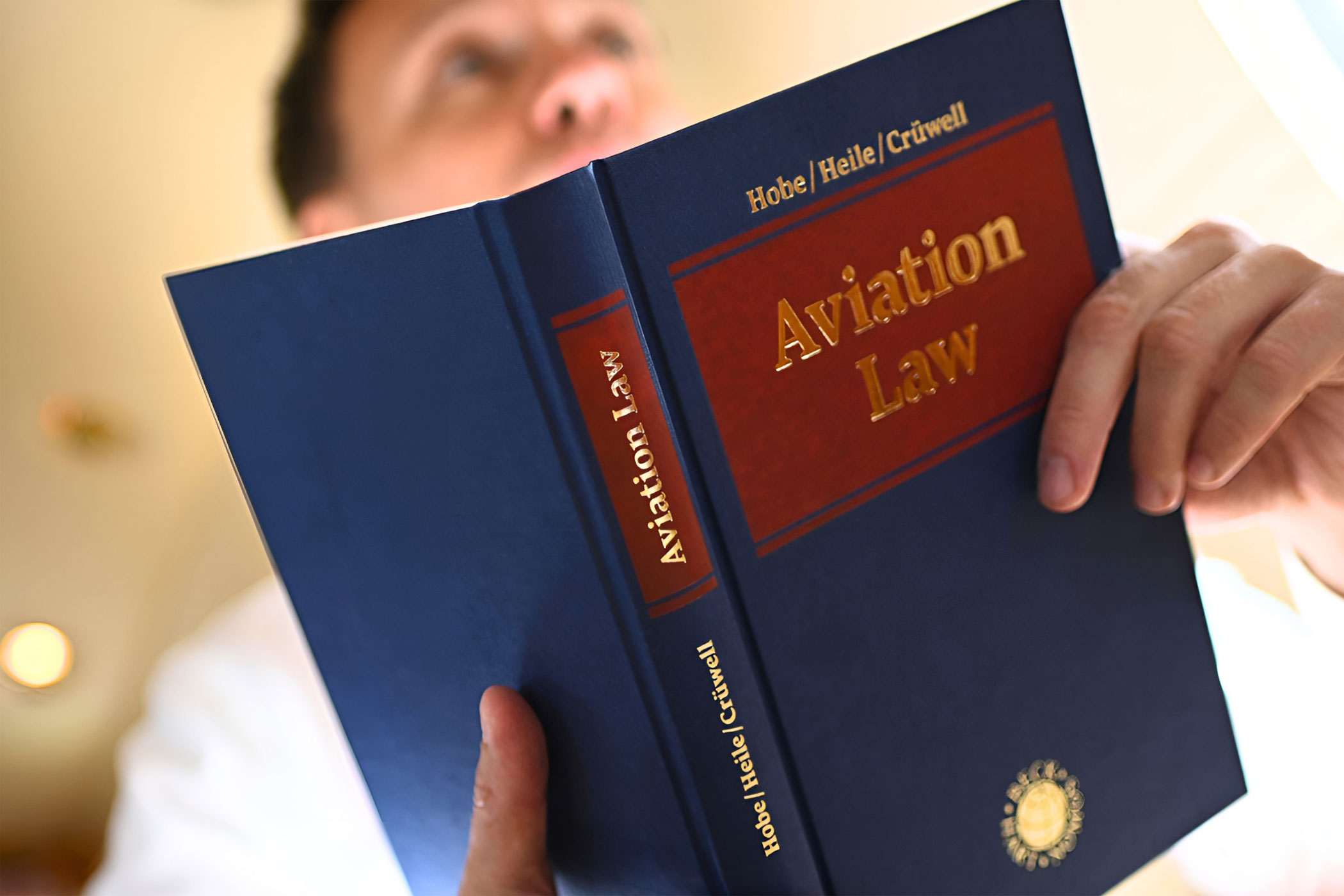
The global aviation sector is undergoing a profound technological transformation. Together with Prof. em. Dr. Stephan Hobe and Carl Crüwell, attorney Dr. Moritz Heile – founder of the Berlin-based law firm GOODVICE – has recently published the English-language professional handbook “Aviation Law”. In an interview with the aviation magazine, the expert provides an assessment of the industry’s most pressing regulatory challenges.
An interview with Dr. Moritz Heile
Luftfahrtmagazin: Dr. Heile, from a legal perspective, where do you currently see the greatest hurdle for the commercial use of passenger and cargo drones in Europe?
Dr. Moritz Heile: I see the biggest legal hurdle in their integration into existing airspace and its regulatory framework – specifically regarding the authorization of regular, economically viable flight operations. After all, a successful test flight is a far cry from a business model that can be approved for commercial operation.
A distinction must be made between cargo and passenger drones: for commercial cargo flights, an extensive legal framework already exists in the form of EU Implementing Regulation 2019/947. In particular, flights conducted beyond the pilot’s line of sight – known as BVLOS (Beyond Visual Line of Sight) operations – are subject to more stringent requirements. Depending on the operational concept, these may necessitate a risk assessment and an official operational authorization; for certain standard scenarios, however, a declaration of operation is sufficient. For unmanned passenger drones, the requirements are significantly higher: under Article 6 of the regulation, the transport of persons falls into the “certified” category, which is subject to particularly rigorous safety standards. For manned, vertical take-off and landing (VTOL) air taxis – referred to as eVTOLs – the EU has since established a dedicated operational legal framework through Regulation 2024/1111.
With regard to airspace integration, the EU has established a legal framework for the so-called “U-Space” through Regulation 2021/664. Within specifically designated airspaces, digital services are intended to facilitate the safe coordination of drone traffic. While the legal foundations are already in place, their practical implementation – and their integration with conventional air traffic – remain challenging. Furthermore, issues concerning liability, insurance, and the authorization of suitable take-off and landing infrastructure must be addressed. For commercial operators – whether in passenger or freight transport – this creates a complex interplay of various legal requirements. Ultimately, the decisive factor will be whether Europe can successfully transition from the certification of individual aircraft to a legally secure and economically viable model for regular operations.
Luftfahrtmagazin: In which areas of air transport – such as flight operations or slot management—will AI most rapidly challenge the existing legal framework?
Dr. Moritz Heile: I see the greatest legal challenges in areas where artificial intelligence is already being used to support or prepare operational decisions: flight planning, predictive maintenance, and air traffic management. This is because the closer AI gets to decisions that impact safety, the more pressing questions regarding certification, responsibility, and – consequently – liability become.
Take maintenance as an example: if an AI system fails to detect a technical defect or provides an incorrect maintenance recommendation, the question arises as to who is legally liable – the software provider, the maintenance company, or the airline? The answer depends, in particular, on the respective legal and contractual responsibilities. Similar questions arise in the context of flight planning and air traffic management. The allocation of airport slots is another interesting example: under Article 4 of EU Regulation 95/93, airport slots must be allocated by independent coordinators in a neutral, transparent, and non-discriminatory manner. If AI systems are used in this process, the statutory allocation criteria must be upheld, and the outcomes must remain traceable.
With the so-called AI Act – Regulation (EU) 2024/1689 – the EU has established a comprehensive legal framework for artificial intelligence. However, the aviation sector is subject to specific requirements: depending on the application, additional aviation-specific safety and certification regulations also apply. The European Union Aviation Safety Agency (EASA) is already developing relevant guidelines in this area, focusing in particular on the reliability, verifiability, and human oversight of AI systems.
The decisive challenge, therefore, will not be whether AI should be permitted for use in aviation, but rather how its deployment can be structured to be safe, legally transparent, and subject to clear lines of responsibility. For one principle must remain valid even in the age of artificial intelligence: while decisions can be automated, legal responsibility cannot simply be delegated to an algorithm.
“Decisions can be automated – but legal responsibility cannot simply be delegated to an algorithm.” — Dr. Moritz Heile, attorney specializing in aviation law
Luftfahrtmagazin: The aviation sector is becoming increasingly digitally interconnected. What regulatory gap do airlines and airports need to address most urgently?
Dr. Moritz Heile: I see the greatest challenge not so much in a lack of legal regulations, but rather in their practical implementation and the interplay between various sets of rules. After all, cyberattacks do not stop at corporate boundaries. In aviation, in particular – where airlines, airports, air traffic control, ground handlers, and external IT service providers are closely linked – security vulnerabilities on the part of a single entity can have far-reaching consequences.
With the European NIS2 Directive (EU) 2022/2555 and the aviation-specific regulations (EU) 2022/1645 and 2023/203 – collectively known as “Part-IS” – there are now extensive requirements regarding cybersecurity. The latter apply to numerous aviation entities as of February 2026, and to the relevant airport operators as early as October 2025. In particular, these regulations mandate that the affected organizations systematically identify and assess information security risks that could impact flight safety, and implement appropriate protective measures.
With the European NIS2 Directive (EU) 2022/2555 and the aviation-specific regulations (EU) 2022/1645 and 2023/203 – collectively known as “Part-IS” – there are now extensive requirements regarding cybersecurity. The latter apply to numerous aviation entities as of February 2026, and to the relevant airport operators as early as October 2025. In particular, these regulations mandate that the affected organizations systematically identify and assess information security risks that could impact flight safety, and implement appropriate protective measures.
In my view, airlines and airports must therefore, in particular, examine and ensure that cybersecurity risks are effectively managed – even beyond their own organizational boundaries. This is no longer merely a technical IT issue; it also concerns the legal responsibility of corporate management. Today, cybersecurity is, in fact, a matter of flight safety. It is not without reason that my co-authors and I have dedicated an entire chapter to this topic in our new handbook, *Aviation Law*.
About Dr. Moritz Heile
Dr. Moritz Heile is an attorney and founder of the Berlin-based law firm GOODVICE. He specializes in aviation law, transport law, and complex commercial disputes. His clients include airlines, business jet operators, airports, and financiers, as well as companies in the transport, freight, and logistics sectors.
Read for you: A review of the specialist handbook “Aviation Law”
Anyone involved in international aviation knows the dilemma: aviation law is highly fragmented, ranging from historic agreements – such as the Chicago Convention – to brand-new EU regulations concerning AI and cybersecurity. With “Aviation Law,” a team of authors led by Prof. em. Dr. Stephan Hobe, Dr. Moritz Heile, and Carl Crüwell has produced a work that fills precisely this gap.
As one works through this 264-page hardcover volume, the successful balance between academic rigor and genuine industry practice immediately becomes apparent. While traditional legal commentaries often remain mired in abstract, granular detail, the influence of practical experience is clearly evident here: the book guides the reader logically through the cornerstones of aviation law – from state sovereignty over airspace and airport regulation to aircraft financing, rights in aircraft, passenger and cargo liability, and the investigation of aviation accidents.
Our highlights from the table of contents
- Modern future-oriented topics: The chapters addressing current drivers of transformation are particularly compelling. Rather than treating drones, autonomous systems, artificial intelligence, and climate protection as mere footnotes, the text analyzes them as an integral component of modern aviation law.
- Interface with outer space: Particularly against the backdrop of the increasing commercialization of spaceflight, examining the legal transitions between air law and space law offers genuine added value.
- Clear structure & language: Although the work is written in English – which is entirely logical and necessary given the international nature of the industry – the style remains precise and highly accessible. This makes it a suitable resource not only as a quick reference guide for the legal departments of airlines, airports, and insurance companies, but also for managing directors, fleet managers, and safety officers who do not hold a formal law degree.
Editorial Conclusion
The English-language hardcover reference book “Aviation Law” is no dusty textbook destined for a bookshelf; rather, it is a highly relevant, practical tool for the desk. For those in positions of responsibility within the aviation sector who wish to understand how traditional aviation law and new digital regulations intersect, these 264 pages offer a reliable compass.
Bibliographic data
- Title: Aviation Law (1st edition 2026)
- Autoren: Stephan Hobe, Moritz Heile, Carl Crüwell
- Publisher: Nomos (distributed globally in partnership with C.H.Beck and Hart Publishing)
- Extent: 264 pages, hardcover
- ISBN: 978-3-7560-1069-1