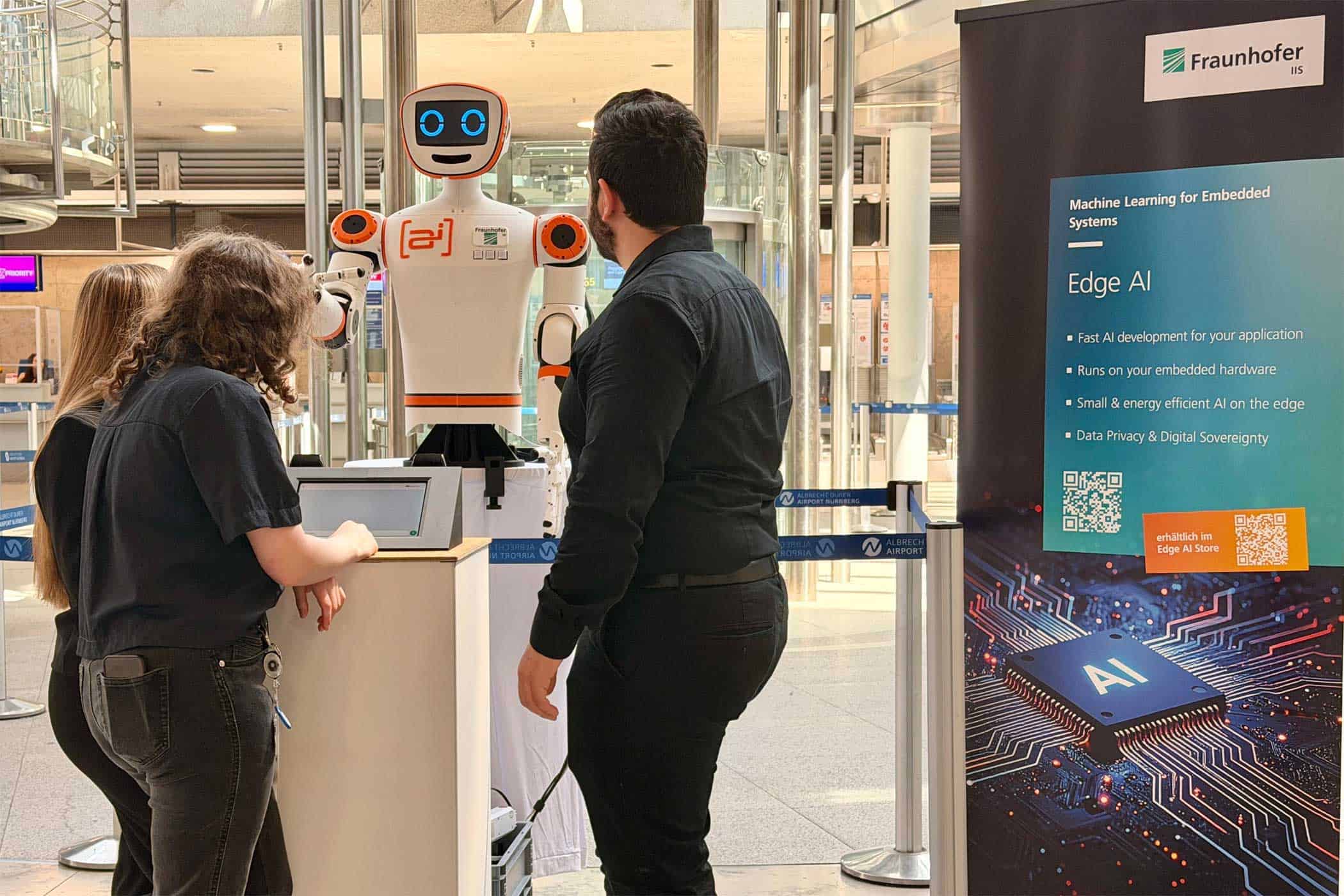
Mobile Robot Assistant with Edge AI in Operation at Nuremberg Airport
Amidst the ongoing digitalization, Artificial Intelligence (AI) and autonomous assistance systems are gaining increasing importance – particularly in public spaces such as airports, where the rapid and targeted dissemination of information is essential. In collaboration with Nuremberg Airport, the Fraunhofer Institute for Integrated Circuits IIS has developed a mobile robotic assistant and tested it in the real-world environment of the departure hall. This AI-powered conversational robot answers travelers’ inquiries regarding topics such as parking options, restaurants, or service counters, proving itself to be a forward-looking solution for enhancing traveler assistance. The deployment of Edge AI technologies enabled the local processing of voice data without reliance on cloud services, thereby safeguarding privacy and enhancing data security. The following presentation outlines the development, functionality, and practical application of this intelligent information assistant at the airport.
Local AI Models as a Key Element for Information Assistance
Modern AI systems based on voice input are currently found primarily in vehicles, digital voice assistants, or website chatbots, and frequently rely on complex, cloud-based models. These require a constant internet connection, which can limit usability in environments with fluctuating network coverage. Consequently, Fraunhofer IIS is pursuing an innovative approach in which three specially compressed AI models run directly on the robot: one model for multilingual spoken language understanding, a Large Language Model (LLM) for content processing and response generation, and a text-to-speech model for speech synthesis in the language selected by the user. The entire processing takes place locally on an edge device, eliminating the need to transmit or store audio data—a crucial advancement for data protection and data sovereignty.
This autonomous solution enables travelers’ diverse inquiries to be answered without delay. Furthermore, the integration of airport-specific information into the AI models ensures precise and context-aware responses tailored to local needs. The result is an interactive user experience that operates in real time, independent of external infrastructure. Thus, not only is traveler convenience enhanced, but the robustness of the information system is also improved.
Advantages and Challenges of Edge AI in Public Spaces
The deployment of Edge AI offers several advantages, particularly in environments such as airports. Since processing takes place directly on the local device, latency is reduced, thereby immediately accelerating interactions with travelers. Furthermore, local data processing significantly enhances data security, as no sensitive voice data is transmitted to external servers. This is not only significant for data protection reasons but also aligns with the growing demands for privacy preservation in AI systems.
However, this approach also presents technical challenges: the AI models must be sufficiently small and efficient to run on resource-constrained embedded systems without sacrificing performance. Researchers at Fraunhofer IIS achieved this through targeted optimization and compression of the models, which nevertheless ensure sufficient accuracy in understanding and generating speech. The development of such highly compact yet powerful models represents a crucial step toward making AI applications practical for use in real-world scenarios.
Furthermore, user acceptance is a crucial factor in the introduction of humanoid assistance robots in public spaces. Intuitive usability and the quality of responses determine whether this form of interaction becomes permanently established among travelers. Consequently, the system’s usability was also evaluated during the field test at the airport in order to gain insights for further development and practical application.
Practical Testing at the Airport and Strategic Importance
The collaboration between Fraunhofer IIS and Nuremberg Airport combines scientific research with practical application. By deploying the mobile information robot in the departures hall, the technical infrastructure could be tested under real-world conditions. Travelers’ reactions provided valuable insights into how well the system is received in everyday use and what improvements are necessary.
A key aspect of this research is its independence from external cloud services, which enables a continuous flow of information in critical situations – for instance, in the event of a Wi-Fi outage or a limited internet connection. This enhances the resilience of the airport’s information systems.
Integrating a Retrieval-Augmented Generation (RAG) system makes it possible to better understand the context of user queries – and to address them with greater precision – by combining local knowledge with generative AI. The strategic deployment of such technologies opens up new horizons for the airport’s digital infrastructure, for instance through the introduction of additional smart services or integration into multimodal assistance systems.
The scheduled presentation of the test results during the Nuremberg Digital Festival also serves as a key platform for showcasing these developments to a broader professional audience, as well as to interested companies and multipliers. This fosters networking with other initiatives that are driving the adoption of AI technologies within public institutions.
Conclusion: Integrating Intelligent AI Solutions into Everyday Life
The pilot project at Nuremberg Airport impressively demonstrates how modern artificial intelligence – in the form of a mobile robotic assistant – can provide travelers with information quickly and safely. Central to this initiative is the use of Edge AI, which enables the processing of all speech and dialogue data directly on the device, without compromising data security or user-friendliness. The successful testing of such autonomous assistance systems under real-world conditions demonstrates that technical challenges can be overcome and that user acceptance is assured.
This development serves as a prime example of the increasing integration of intelligent AI solutions into everyday life, demonstrating how innovative technologies can enhance service at high-traffic transportation hubs. Future advancements could encompass additional functionalities – further overcoming linguistic and cultural barriers – thereby boosting the overall appeal and efficiency of the airport experience.
The clear focus on data sovereignty and independence from cloud infrastructures not only meets data protection requirements but also ensures the stability and availability of such systems – a decisive advantage in dynamic environments with high information demands. The combination of technological advancement and practical application makes this project a key milestone on the path toward intelligent, data-secure assistance systems for public spaces.