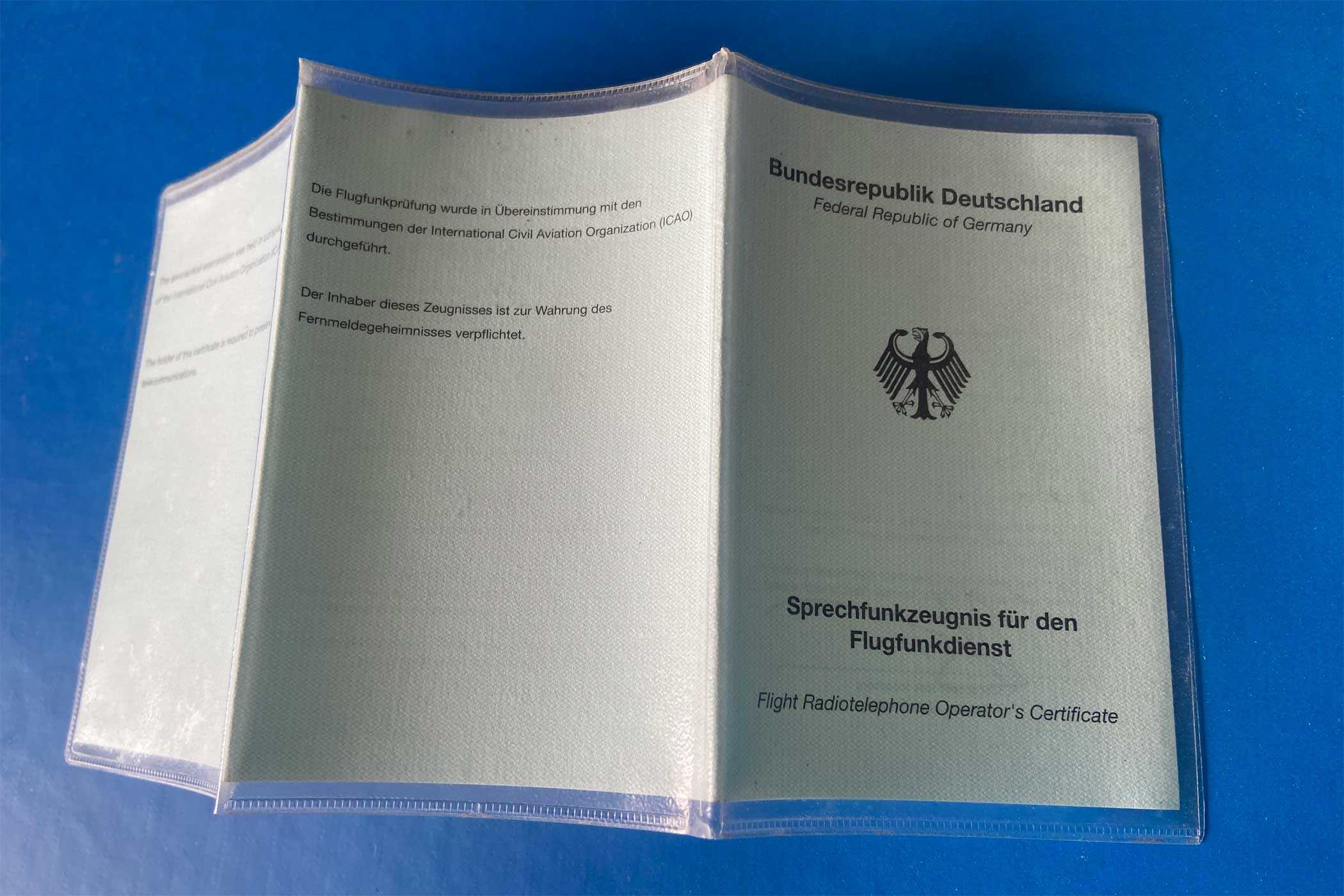
Communication in the cockpit: The path to becoming a radio professional
Anyone who wants to take to the skies needs to be able to communicate. But the path to a legal radio operator’s certificate often resembles a bureaucratic slalom. Between the BZF (German radio operator’s certificate), AZF (German radio operator’s certificate), and the ICAO language proficiency test, student pilots and experienced pilots alike can easily lose track. We’ll explain: What am I allowed to do with which certificate – and how do I stay “legal”?
The foundation: The radio operator certificates (BZF & AZF)
In Germany, radio operator certificates form the legal basis for operating radio stations on board ships. Unlike language proficiency certificates, they are valid for life.
BZF II (National, VFR)
The classic entry-level certificate. It authorizes radiotelephony in German only within Germany under visual flight rules (VFR).
BZF I (International, VFR)
The extension for cross-border traffic. It allows radio communication in German and English (VFR) and is a prerequisite for flights abroad.
AZF (General Radiotelephony Certificate, IFR/VFR)
The “premier class”. It is required for flights under Instrument Flight Rules (IFR) and automatically covers all VFR ratings. An AZF cannot be obtained directly; it requires a BZF I or II.
Required reading: ICAO Language Proficiency
Since 2011, a radio operator’s certificate alone is no longer sufficient for English language proficiency. Pilots with a BZF I or AZF must also provide proof of ICAO language proficiency. This does not test rigid phraseology, but rather general understanding and responsiveness in English.
- Level 4 (Operational): The minimum level. It must be renewed every 4 years.
- Level 5 (Extended): For advanced learners. Valid for 6 years.
- Level 6 (Expert): Only for (near) native speakers. Once passed, this certification is valid for life.
Comparison table of radio operator certificates: Radio licenses and authorizations
| Transcript | Target license | Flight rules | Language | Validity | Special feature |
|---|---|---|---|---|---|
| BZF II | LAPL / PPL | VFR only | Only German | Permanent | Valid only in Germany. |
| BZF I | PPL / CPL | VFR only | German English | Permanent | Mandatory for international flights. |
| AZF | CPL / ATPL | VFR & IFR | German English | Permanent | Highest level; required for IFR rating. |
| ICAO L4 | PPL / CPL | – | English | 4 years | Minimum level for English radio communication. |
| ICAO L6 | ATPL / Career | – | English | Permanent | No repeat exam is necessary. |
Checklist for preparing for and the costs of obtaining a radio operator’s certificate
To not only pass the exam, but also to operate confidently on the radio, targeted preparation is recommended:
- Training: Use online simulators such as the LP test from Flight Support or listen to real radio traffic on LiveATC.net.
- Testing centers: The Federal Network Agency offers cost-effective testing (approx. €86) up to Level 4. Independent providers such as GAT or sayagain.aero offer flexible online appointments for Levels 4 to 6 (cost: approx. €190 to €395).
Market overview: Costs from independent providers
While the Federal Network Agency offers a fixed price, the fees at LBA-approved organizations (LTOs) vary depending on the level and scope:
| Performance | Provider examples & terms and conditions | Price range (approx.) |
|---|---|---|
| Initial Level 4 Examination | e.g. GAT German Aviation Training (€199) or Blue Sky Aviation (€195) | €190 – €200 |
| Extension level 4 | Cheaper than initial exams, often possible online. | €135 – €150 |
| Initial exam Level 6 | Often requires two examiners; e.g. AIR-SPEAK air-speak.eu (€220) or Blue Sky (€395). | €220 – €395 |
| Additional services | Express certificates delivered within a few days often cost extra. | + €25 – €50 |
Note: Associations such as the DAeC German Aero Club often offer flat rates for members (e.g. €200 including preparation).
Important for planning: Be aware that German authorities only recognize German LTOs for licenses issued in Germany – examinations at foreign organizations are often not recorded.
License check: What do PPL, CPL and ATPL require?
The choice of radio operator’s certificate depends largely on the intended purpose of the flight. While the minimum qualification is often sufficient for recreational pilots, the path to becoming a professional pilot is clearly defined.
PPL (Private Pilot License) / LAPL
For the typical private pilot who only wants to fly within Germany and during the day, the BZF II is sufficient. However, as soon as a border crossing is planned or the night flight rating (NVFR) is acquired, the BZF I along with ICAO language proficiency (at least level 4) is mandatory.
Tip: Anyone who wants to upgrade to IFR later should aim directly for the BZF I.
CPL (Commercial Pilot License)
Commercial pilots operate in a professional environment that almost always requires the BZF I (German radio operator’s certificate). Since commercial flights often involve international destinations or take place in controlled airspace, proof of English language proficiency is practically standard. Many employers in the charter or business aviation sector also require an AZF (German air pilot’s certificate), as the aircraft are usually operated under instrument flight rules (IFR).
ATPL (Airline Transport Pilot License)
For the “full” license, the AZF (German Airline Proficiency Certificate) is absolutely essential. Since airline pilot training necessarily includes the Instrument Rating (IR), radio communication in English at an expert level (AZF + ICAO language proficiency certificate) is a basic requirement.
Career factor: Many airlines now require ICAO Level 5 or 6 for hiring to ensure seamless communication across their global network. Level 4 can already be a disqualifying factor in the application process.
Overview of licensing requirements
| Lizenztyp | Min. Radio certificate | Recommended language level | Reason |
|---|---|---|---|
| LAPL / PPL | BZF II (VFR nat.) | Level 4 (bei BZF I) | Basic license, international flights optional. |
| CPL | BZF I (VFR int.) | Level 4 / 5 | Commercial use, often abroad. |
| ATPL | AZF (IFR) | Level 5 / 6 | Worldwide scheduled flight, IFR required. |
Example exam: When the routine ends
In the Level 4 exam, the examiner often simulates an unexpected situation. Memorizing codes is not what counts here; rather, it’s the ability to react freely (“Plain English”).
Scenario: You are approaching when a problem suddenly occurs.
- Examiner (Tower): “D-EXYZ, cleared to land runway 26, wind 240 degrees, 8 knots.”
- Pilot (you): “Cleared to land runway 26, D-EXYZ. – Wait, Tower, D-EXYZ, we have a problem. There is a large bird, looks like a buzzard, sitting right on the centerline of the runway.”
- Examiner (Tower): “D-EXYZ, roger. Can you perform a touch-and-go to scare the bird away?”
- Pilot (you): “Negative, I am low on fuel and I don’t want to risk a birdstrike. I will go around and wait for you to send a follow-me car to clear the runway.”
Why that’s enough for level 4
- Understanding: You have correctly acknowledged the landing clearance.
- Description: You were able to precisely name the problem (“bird on centerline”).
- Interaction: You responded to the Tower’s (risky) suggestion, rejected it, and provided a reasoned alternative (“low on fuel”, “follow-me car”).
The basics of abbreviations
- VFR / IFR: Visual / Instrument Flight Rules (Visual Flight / Instrument Flight).
- BZF / AZF: Restricted / General Valid Radiotelephone Operator’s Certificate.
- ICAO: International Civil Aviation Organization.
- LTO: Language Testing Organisation (Approved language testing organization).
- FCL.055: The specific part of the EU regulation on the licensing of pilots that governs language skills.
- BNetzA: Federal Network Agency (responsible for radio testing in Germany).
Contact & Addresses: Where can I find the dates?
Further information and registration for the exams
- Federal Network Agency (BNetzA): For radio operator tests (BZF/AZF) and language proficiency tests up to level 4.
- www.bundesnetzagentur.de (Suche: Flugfunkzeugnisse)
- German Federal Aviation Office (LBA): List of approved testing bodies (LTOs) for Level 4, 5 and 6.
- www.lba.de (Section: Aviation personnel > Language skills)
- DAeC & DULV: The air sports associations often offer their own dates for their members.
- www.daec.de / www.dulv.de
Conclusion: Radiotelephony certificate for PPL, CPL and ATPL
For those who want flexible flying options today, the combination of BZF I and ICAO Level 4 is the best choice. Those aiming for a career as a professional pilot should consider the AZF and ICAO Level 6 to reduce bureaucratic hurdles in the long run. While the BZF II is sufficient for a Sunday flight, the BZF I with ICAO Level 4 is the “ticket to the world” for ambitious pilots. Aspiring professionals should plan for the AZF and a high level of language proficiency early on to impress airlines.