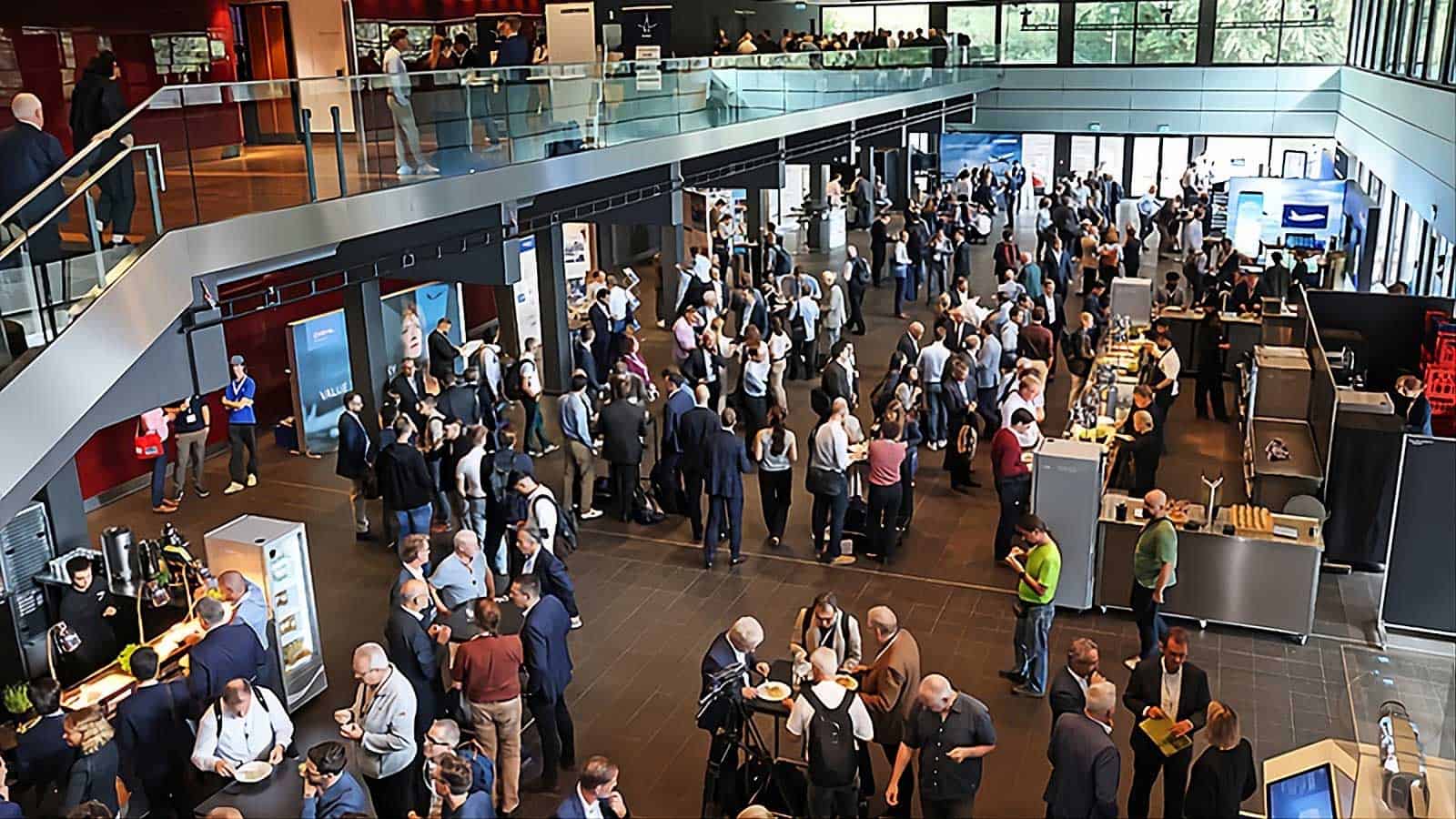
Overview of the Major Aerospace Congress in Aachen
The 75th German Aerospace Congress took place in Aachen in September 2026, drawing a record attendance of approximately 1,150 industry professionals. As one of Germany’s most important aerospace events, this scientific and technical forum brought together experts from industry, research, and the political sphere. Three highly topical key themes were addressed: new aircraft programs and the associated skills required, the growing strategic importance of spaceflight, and technological challenges in the fields of security and defense.
The congress took place at Eurogress Aachen and fostered professional exchange through a total of 450 technical presentations, 70 posters, and seven plenary lectures. Furthermore, the event featured numerous panel discussions and diverse networking opportunities that advanced collaboration between academia, industry, and the policy sector within the aerospace field.
Linking development and production for a successful aerospace industry
A key topic of discussion at the congress was how new technological insights can be rapidly translated into industrial value creation. It was emphasized that, in the future, development and production within the aerospace sector must collaborate much more closely than before. Design for manufacturing and assembly, as well as standardization, are fundamental requirements for efficiently achieving higher production volumes. This also entails integrating robotics, artificial intelligence, and digitalization into development processes at an earlier stage in order to bring innovative technologies to market maturity more quickly.
Growing demand in the aviation sector significantly exceeds current production capacities. At the same time, the market for space services has doubled within five years. This creates the challenge of rapidly achieving the required production volumes, requiring Germany to leverage its traditional expertise in industrial serial production more effectively within the aerospace industry. Beyond a product’s technical perfection, the focus is now shifting to reliability as well as rapid, scalable, and cost-efficient manufacturing. This perspective broadens the understanding of value creation and places new demands on planning and management within aerospace companies.
Digitalization and Data Integration: Keys to Boosting Efficiency in Aviation
A key focus within the aviation sector has been the systematic use of digital technologies for operations and maintenance. One example is the digitalization of daily aircraft inspections, which have traditionally been labor-intensive and time-consuming. Camera technology, for instance, enables the automated monitoring of tire conditions, significantly enhancing the safety and efficiency of inspection processes. Similarly, electronic technical logs are replacing traditional paper logbooks, facilitating better data availability and analysis, thereby raising safety standards.
Innovative sensor technologies enable the automated monitoring of parameters such as oil levels, which were previously checked manually. The resulting freed-up personnel resources can be utilized for innovation and safety improvements. The use of artificial intelligence opens up further opportunities: AI-based turbulence predictions allow for better flight route planning and more targeted adjustments, thereby enhancing travel comfort and safety – particularly for individuals with special needs.
However, the congress also highlighted structural challenges: currently, much important information resides in isolated data silos, hindering efficient data exchange. A shift towards interconnected platforms and ecosystems is necessary to utilize data effectively and sustainably in the future. Combining improved data availability with cooperation between industry, academia, and policymakers could thus significantly enhance efficiency, sustainability, and accessibility in aviation.
Sustainability and Green Technologies for the Future of Aviation
Emissions from the aviation sector are the focus of numerous initiatives aimed at achieving climate goals. The conference devoted significant attention to the question of how “green flying” can be realized. Short-term solutions rely primarily on sustainable fuels, though their limited availability poses a challenge. In the long term, green hydrogen is being intensively discussed as a fuel, with the aim of making it more cost-effective than fossil-based jet fuel by 2050. However, success depends not only on new fuels but also on technological innovations – such as the systematic avoidance of contrails through optimized flight paths and the evolutionary advancement of aircraft engines.
For the sector to achieve its climate goals, greater interdisciplinary collaboration – extending beyond isolated optimizations – is required. The combination of technology development, regulatory support, and industrial implementation is fundamental to sustainable progress. Furthermore, networking across different clusters and breaking down traditional silos enable a holistic perspective, which is essential for achieving both economic and environmental success.
Space strategies and independent capabilities in Europe
The economic significance of space exploration is growing rapidly, a fact clearly demonstrated by the next generation of space stations. Research conducted in weightlessness yields insights – such as in materials science or life-support systems – that cannot be obtained on Earth. At the same time, these platforms play a crucial role in preparing for crewed missions to the Moon or Mars. Europe currently faces the challenge of more effectively strengthening its role in shaping the post-ISS era. For now, however, the American space agency and its industry remain the dominant forces in this phase.
Mastering integrated space capabilities is essential for a strong European space sector. This entails, in particular, developing and controlling critical technologies and interfaces to reduce reliance on global dependencies. Infrastructure plays a key role in fostering competitive enterprises and supporting outstanding European space companies. Developing national and European capabilities – including dedicated launch sites – was deemed necessary to guarantee rapid and secure access to space, particularly within the context of security and defense.
Security and defense in the age of digital warfare and space-based systems
The timeframes for military responses are shrinking drastically due to the use of space-based data and communications. Modern warfare is inconceivable without satellite technologies and can even be decisively influenced by them. The Bundeswehr relies on key capabilities – such as satellite communications, sensor technology, and geoinformation – to secure an information advantage during operations. However, reliable access to space is considered critical, as there is no guarantee of availability from European launch sites like Kourou in the event of a crisis or war. Consequently, developing domestic launch capabilities is viewed as a strategic objective for Germany.
Furthermore, new technological requirements are leading to changes in strategic planning at both national and international levels. Data security, rapid data transmission, and analytical capabilities form the foundation for military operational readiness. Consequently, aspects such as digitalization, cyber defense, and technological advancement are high-priority items on the agenda.
The ongoing scaling and economic growth of the space sector
The globally expanding space industry is growing by approximately ten percent annually. At the same time, ambitions – driven by increasingly complex missions – are rising faster than the available financial resources. Rather than increased investment, the development of more affordable and efficient technologies is viewed as the key factor. The ESCAPADE mission, which plans a journey to Mars at one-fifth of the previous cost, underscores this trend toward cost and efficiency optimization.
The availability and frequency of space launches are critical competitive factors. While the United States and China achieve a high number of launches per year, Europe lags behind. This disparity in volume prevents existing competitive advantages from being fully leveraged. Increasing launch frequency is considered a key priority for keeping pace in terms of the speed of innovation and spaceflight capabilities.
Fostering the next generation of scientists as a foundation for sustainable progress
The availability and frequency of space launches are critical competitive factors. While the United States and China achieve a high number of launches per year, Europe lags behind. This disparity in volume prevents existing competitive advantages from being fully leveraged. Increasing launch frequency is considered a key priority for keeping pace in terms of the speed of innovation and spaceflight capabilities.
Fostering the next generation of scientists as a foundation for sustainable progress
A particular highlight was the inaugural Students Summit, which featured an interactive stakeholder simulation demonstrating the complexities involved in successfully implementing sustainable technologies within a landscape of competing interests. Students had to understand and balance the perspectives of airlines, policymakers, technical experts, and regulators while working to reach compromises. Such practical formats foster an understanding of real-world challenges and the importance of dialogue and collaboration – essential skills for the leaders of tomorrow.
Outlook and Significance of Future Aerospace Congresses
The “Heide spirit” of networking, the transfer of innovative technologies, and the fostering of up-and-coming talent will continue to play central roles in future congresses. The next event is scheduled for September 14–16, 2027, in Bremen. There, current technological developments will be presented, and important impetus will continue to be provided for dialogue among industry, academia, and policymakers.
Overall, the event reflects the diverse challenges and immense dynamism of the aerospace sector. The combination of digitalization, sustainability, security, and international competitiveness places demands on all stakeholders alike. It is essential to pool expertise, rapidly integrate technological advancements, and accelerate the innovation cycle in order to meet the high demands of the global landscape and strengthen Germany’s position in the sector for the long term.