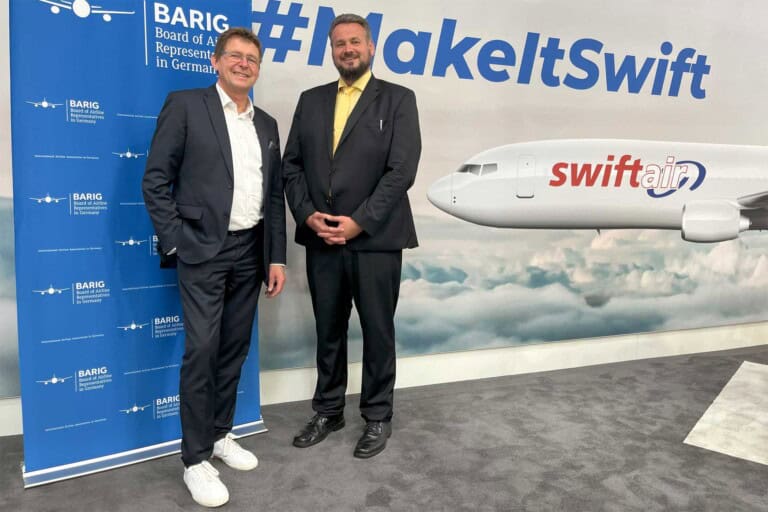
The international aviation association BARIG (Board of Airline Representatives in Germany) sees some positive aspects in the recent decision by the German Federal Cabinet to lower the air traffic tax on July 1, 2026, but also significant drawbacks. BARIG Chairman and Executive Director Michael Hoppe explained:
“In light of current geopolitical challenges, which are also significantly impacting air transport, the massive problem of excessively high government spending in Germany remains. These costs are not only hindering growth but have also led to a shift of traffic to other European countries for years. Passenger and freight capacities continue to be under pressure. Connectivity is suffering immensely, and with it, Germany’s heavily export-oriented economy.”
Excessive cost pressure; flight supply in Germany is not recovering
Air travel in Germany is caught in a downward spiral of excessive government costs, over-regulation, and unequal global competition. It has been demonstrably proven that the cost situation is significantly more competitive in almost all other European countries. Even after the planned reduction in air passenger duty, the cost burden for a flight from Europe in Germany is still almost twice as high as the EU average. This was recently confirmed in an analysis by the German Airports Association (ADV). This is alarming and will lead, in the medium and long term, to a failure to recover the number of flights in Germany due to excessive cost pressures, further price increases, and fewer and fewer people being able to afford to fly.
The federal government must sustainably strengthen Germany as an aviation hub.
The Federal Cabinet’s recent decision to lower the air passenger tax on July 1, 2026, is a step in the right direction – but far too short. The announced reduction doesn’t even bring it back to the level agreed upon in the coalition agreement before the last increase in 2024. Flying will therefore remain far too expensive. In the interest of citizens and the domestic economy, the Federal Government must finally take more decisive and sustainable action to strengthen Germany’s position as an aviation hub. We therefore appeal to the Federal Government to reduce the air passenger tax at least to the 2024 level and, furthermore, to urgently implement additional relief measures for air traffic control and aviation security fees, as well as other government taxes and fees.
About BARIG
BARIG (Board of Airline Representatives in Germany e.V.) represents the common interests of more than 100 national and international airlines in the passenger, tourism, low-cost, and air freight sectors. Since its founding in 1951, the airline association has worked to improve the framework conditions for air transport in Germany and serves as a point of contact for policymakers, government agencies, businesses, and the media.
More about BARIG