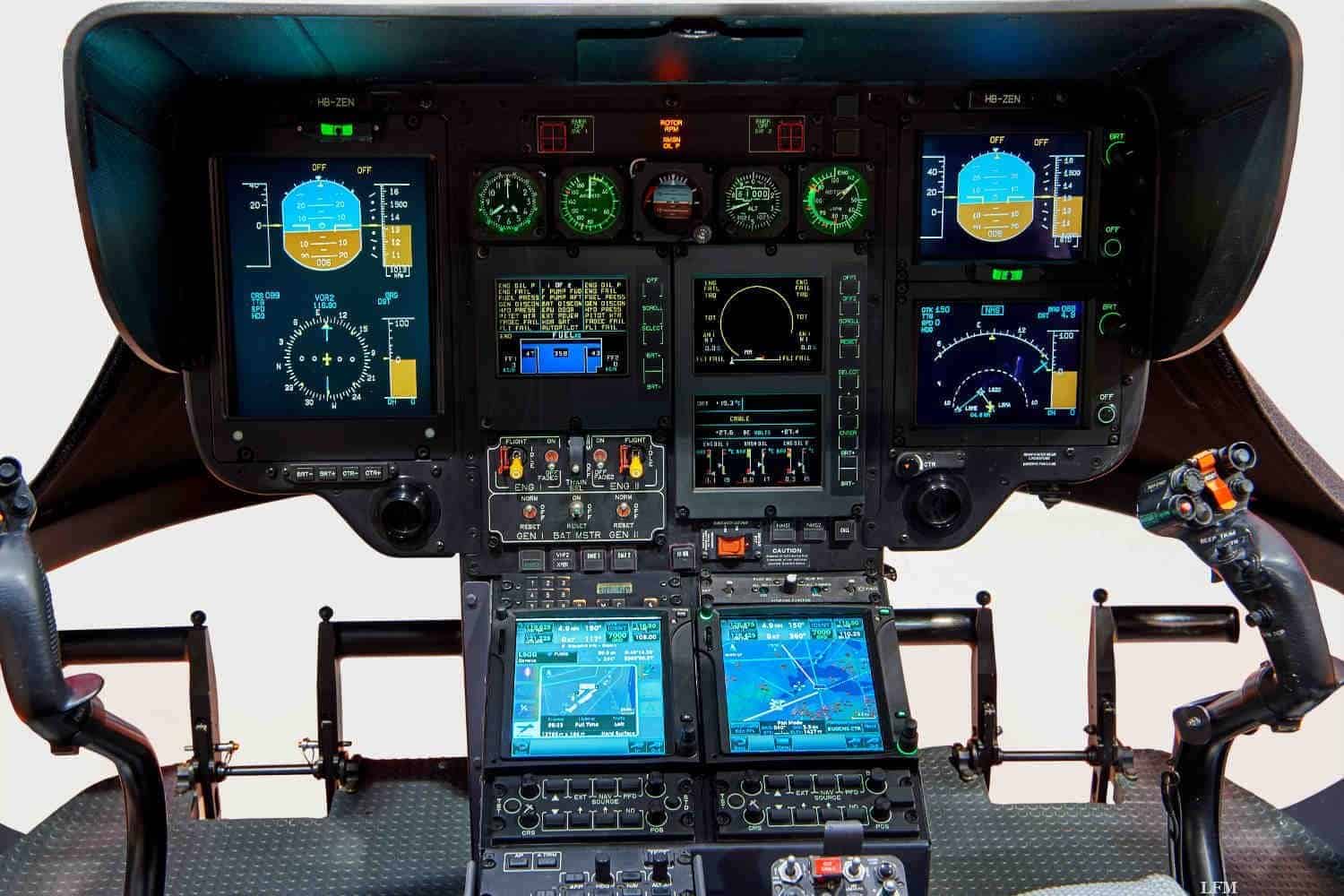
The Swiss technology company Ruag has successfully modernized the cockpit of an Airbus EC135 T2+ rescue helicopter belonging to the Geneva University Hospital – Switzerland’s largest university medical institution.
The comprehensive overhaul included the installation of two state-of-the-art Garmin GTN 750 GPS/NAV/COMM multifunction displays, combined with a GTX 33ES remote transponder and an EASA-compliant Usage Monitoring System. Furthermore, an annual platform maintenance check was carried out during the aircraft’s downtime for the modernization work.
The Geneva University Hospital (HUG) operates a single Airbus EC135 T2+ rescue helicopter, deploying it for transfers between various hospitals, for accident and rescue missions in Switzerland and the adjacent French border region, as well as for water rescue operations on Lake Geneva. After more than twelve years – during which the number of annual missions steadily increased – the HUG helicopter required an avionics upgrade to improve cockpit ergonomics, reduce pilot workload, and ensure compliance with all regulations set by the European Union Aviation Safety Agency (EASA).
The latter required the installation of a new Usage Monitoring System (UMS), new 8.33 kHz-capable radio equipment, and a new surveillance transponder with a minimum capability of Mode S Level 2. RUAG Aviation was commissioned to carry out these modifications, as well as additional maintenance services, during this downtime.
“The solution provided by RUAG was extremely advantageous for us and, thanks to the rapid delivery, enabled us to achieve cost savings. The state-of-the-art Garmin touchscreens support the industry’s latest cockpit functions and simplify the pilots’ work. Furthermore, the new configuration renders the helicopter EASA-compliant and extends its service intervals,” says Adrian Hirt, Technical Director at HUG.
RUAG commenced the helicopter upgrade on October 19, 2015, and redelivered the platform on November 27, 2015 – a remarkably short turnaround time for a project of this scope and complexity. “In just six weeks, we replaced the helicopter’s entire GPS system, transponder, and radio equipment with two state-of-the-art Garmin GTN 750 GPS/NAV/COMM multifunction displays and a GTX 33ES remote transponder.”
“In addition, a new Health and Usage Monitoring System (HUMS) was installed, which contributes to improving the helicopter’s reliability, safety, and availability. The upgrade significantly modernized the cockpit – it now not only meets EASA requirements but also reduces pilot workload through digitized, visualized, and intuitively designed controls, which is equally important,” explained Claudio Zeiter, Team Leader, Commercial Helicopter Services, RUAG Aviation.
The integration is certified for Instrument Flight Rules (IFR) and Precision Area Navigation (P-RNAV). The Garmin unit’s integrated terrain display enhances situational awareness regarding hazards and obstacles – a feature of particular importance for pilots conducting rescue missions in mountainous terrain. Furthermore, RUAG replaced the helicopter’s transponder system with a Garmin GTX 33ES unit, which can be controlled remotely directly via the Garmin GTN 750 touchscreen display. Compared to a conventional transponder control head, this results in significant space savings on the instrument panel while simultaneously improving the integration of the overall system.
As part of its upgrade and MRO projects, RUAG Aviation places great emphasis on uncompromising reliability and transparency. Through constant communication with the HUG team, both decision-making processes and workflows were accelerated – a factor that also contributed to the rapid turnaround time.