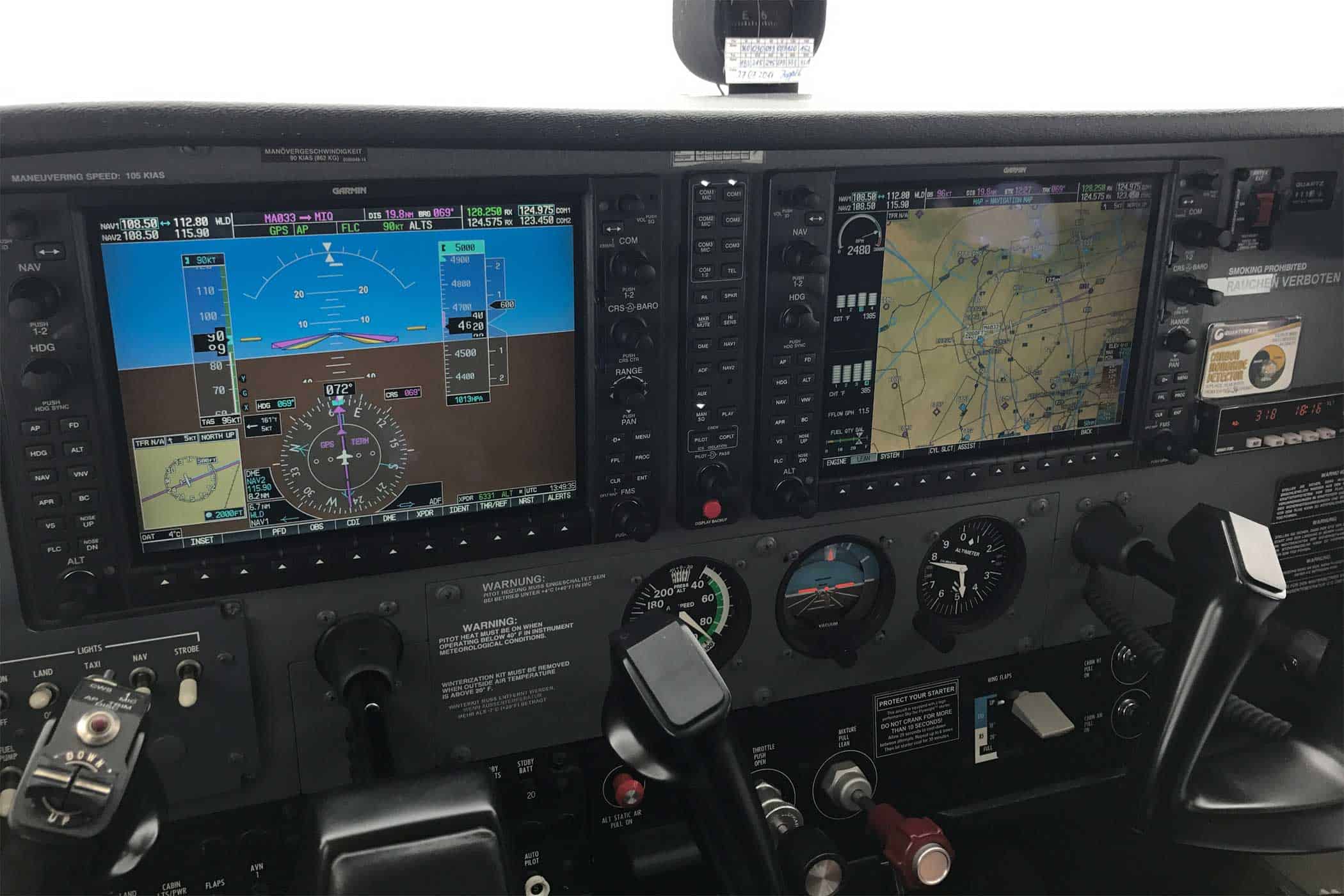
What are squawk codes?
Squawk codes are four-digit numerical combinations assigned by air traffic controllers to pilots in order to uniquely identify an aircraft on radar. They are set via a device known as a transponder, located on board the aircraft, and transmitted to ground radar systems. Technically, the system is based on Secondary Surveillance Radar (SSR), which specifically sends signals to aircraft and processes their responses.
The codes consist of the digits 0 to 7 (octal system), so that a total of 4,096 possible combinations exist (0000 to 7777).
How the transponder works
The transponder is an electronic device that responds to radar interrogations. As soon as an air traffic controller assigns a squawk code to an aircraft, the pilot sets it in the cockpit. The transponder then transmits:
- the set code (Mode A),
- the speed,
- the flight altitude (Mode C),
- and in modern systems additional data such as the unique aircraft identifier (Mode S).
Mode S is now standard in many airspaces because it allows for more precise identification and supports collision warning systems such as TCAS.
Significance and use in air traffic
Squawk codes are essential for air traffic control. Much has changed since the early days of radar technology. In the past, air traffic controllers saw only dots on a screen. Today, transponders provide detailed data:
- Unique Identification: Air traffic controllers immediately see which radar target corresponds to which flight.
- Traffic surveillance: Particularly in heavily trafficked airspaces.
- Coordination between control units: Codes are often handed over or changed during transitions between airspaces.
A typical scenario: A pilot takes off, receives an individual squawk code while taxiing or shortly after takeoff, and is thus tracked for the entire flight route.
Important standard codes
Some squawk codes are internationally standardized and signal special situations:
- 7500 – Aircraft Hijacking (Hijacking / “seven-five – man with a knife / stay alive”): Used discreetly to report an aircraft hijacking.
- 7600 – Radio Failure (“seven-six – hear nix / radio nix / need a radio fix”): Signals that the radio connection to Air Traffic Control is disrupted (total loss of radio communication (Lost Comm)).
- 7700 – Emergency (Emergency / “seven-seven – going to heaven / falling from heaven / pray to heaven / close to heaven”): General emergency code for medical or technical problems (e.g., Mayday, in-flight emergency, engine failure, medical emergency).
These codes have the highest priority and trigger immediate responses from air traffic control.
Regional and temporary codes
In addition to emergency codes, there are also regional standard codes. For example:
- 7000: In many European countries, a general VFR code (visual flight without specific ATC assignment).
- 1200: Corresponding VFR code in the USA.
In addition, codes are dynamically assigned to individually identify aircraft.
Special Codes (SUC) in Germany
0020 – Helicopter Rescue Flights
0023 – Operational Flights of the Federal Police
0024 – Military flights within the night low-level flight system conducting terrain-following flights.
0025 – STOL Aircraft
0027 – Aerobatic Flights
0030 – Survey Flights
0031 – “Open Skies” Flights
0032 – VFR Flights by Civil Aircraft in the Identification Zone
0033 – VFR flights by military aircraft between GND and FL 100
0034 – SAR Operations
0035 – VFR/IFR Transition Procedures
0036 – Police Operational Flights
0037 – Police Operational Flights Using Image Intensifiers
1000 – IFR/Mode S transponder code
2000 – Military Flights in the Night Low-Level Flight System
3701 – FMC in the Langen Test Area
7000 – VFR Flights by Civil Aircraft
Transponder Operation
The four digits of a transponder code (squawk) are individually set to the value assigned by Air Traffic Control (ATC) using the code selector. Depending on the device type, input is performed via pushbuttons or rotary switches.
⚠️ Important Note: Each digit of the four-digit code is based on the octal system and can only take values from 0 to 7.
Transponder Operating Modes
| Mode | Designation | Function & Behavior |
|---|---|---|
| OFF | Off | The device is completely deactivated. Note: After switching on, a warm-up time of 2 to 3 minutes is required. |
| SBY | Standby | The device is ready for operation and preheated, but is not yet transmitting any signals. |
| ON | Mode A | The transponder is active but is not transmitting altitude encoding. This mode of operation is not used in Germany. |
| ALT | Mode C / S | Standard operating mode. Transmits the identification code as well as the current altitude (in 100-foot increments). When prompted to “Squawk,” ALT must always be selected automatically. |
Special Function: The IDENT Key
The IDENT button serves to quickly and uniquely identify the aircraft on the air traffic control radar screen.
- Usage: Exclusively upon explicit instruction from Air Traffic Control (“Squawk Ident”).
- Function: A brief press is sufficient. The transponder transmits an additional identification pulse for approximately 15 seconds.
- Effect: The target symbol on the pilot’s radar display flashes or stands out visually.
In addition, codes are dynamically assigned to individually identify aircraft.
Squawk codes are a key security tool, but also prone to errors:
- Incorrect Entries: A transposed digit can lead to mix-ups.
- Code Conflicts: In rare cases, identical codes may occur simultaneously, requiring additional attention.
Modern systems reduce these risks through automated allocation and better integration with flight schedule data.
Historical background
The term “squawk” originates from early military and radar technology. It was likely adopted from radio jargon and describes the “squawking” – or transmitting – of a signal in response to an interrogation.
With the development of secondary radar in the 1940s and 1950s, squawk codes became an integral part of civil aviation.
Conclusion
Squawk codes are an inconspicuous yet indispensable element of modern aviation. They ensure that aircraft worldwide can be safely tracked, identified, and coordinated. Despite their simple structure, they play a crucial role within a highly complex system that safely brings thousands of flights to their destinations every day.