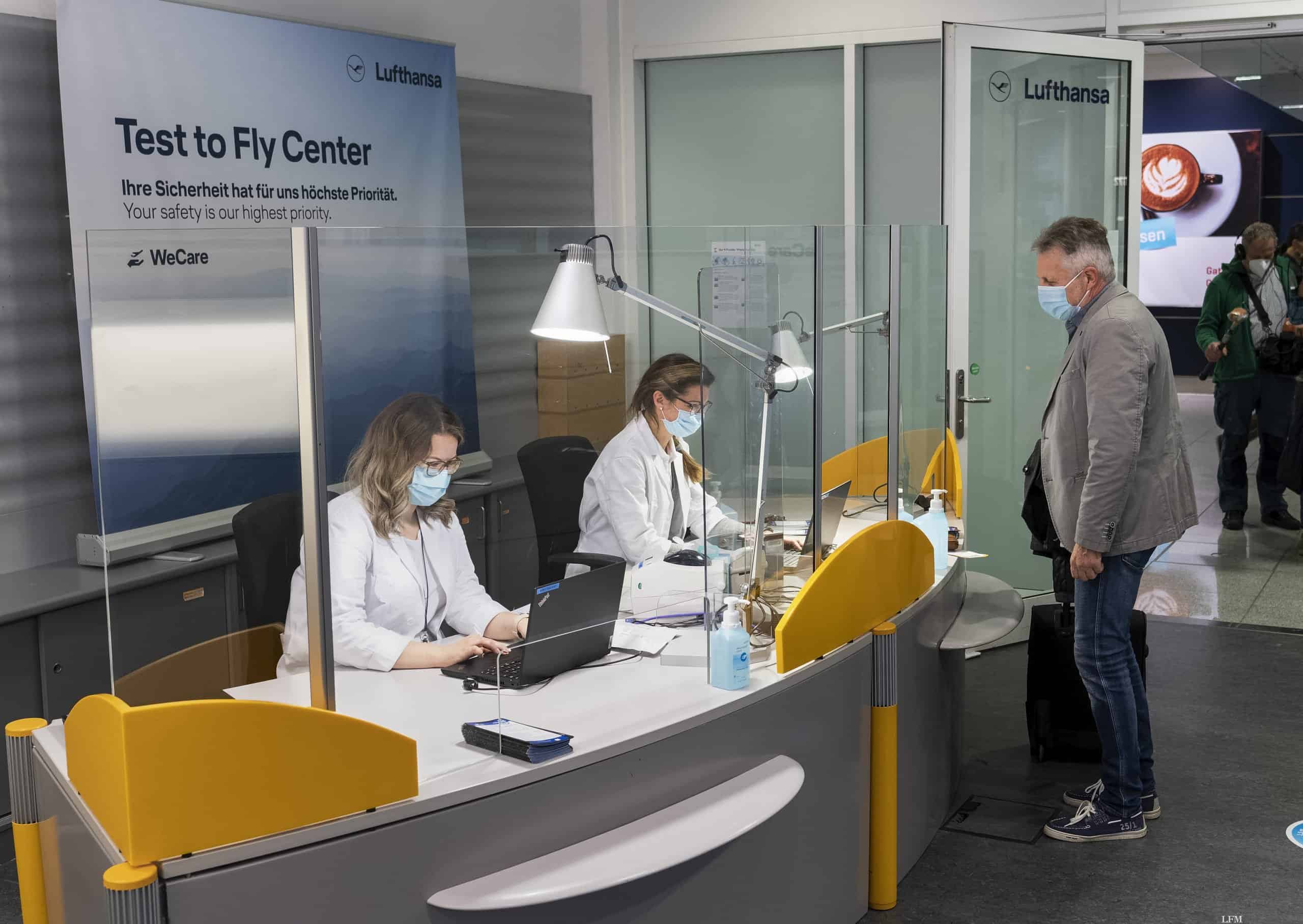
The first Lufthansa flight to Hamburg, on which all passengers had previously tested negative for Covid-19, departed from Munich: LH2058, leaving Munich at 9:10 a.m., marks the start of rapid Covid-19 antigen tests on two daily flights between the two cities. After the test, passengers received their results quickly via push notification and email. All passengers on the flight tested negative and were able to continue their journey to Hamburg. All test results were also negative on the second daily flight, LH2059 from Hamburg to Munich.
Cooperation with Munich and Hamburg airports
In close cooperation with Munich and Hamburg airports, as well as the biotech companies Centogene and the Medicover Group’s medical center, MVZ Martinsried, the airline is offering its customers the opportunity to be tested for COVID-19 free of charge before departure on its two daily flights. Passengers who do not wish to be tested will be rebooked on an alternative flight at no extra cost. Boarding passes will only be activated and access to the gate granted upon receipt of a negative test result.
Rapid test at no extra cost
Alternatively, passengers can present a negative PCR test result that is no more than 48 hours old at the time of departure. Lufthansa will handle the entire rapid testing process. There are no extra costs for the passenger. They simply need to register in advance and allow a little extra time before departure.
Ola Hansson, CEO of Lufthansa Hub Munich, says: “We want to expand global travel options for our customers again, while adhering to the highest hygiene and safety standards. Successfully testing entire flights can be a key factor in this. With our test flights, which successfully launched today, we are gathering important insights and experience in the use of rapid tests.”
Jost Lammers, CEO of Munich Airport GmbH, adds: “The trial run with rapid antigen tests on selected Lufthansa flights is a positive and important signal for the industry. Beyond the extensive hygiene measures that airports and airlines already have in place for passengers, these tests offer an additional level of safety. This could make cross-border travel without mandatory quarantine possible again in the future – provided corresponding international agreements are reached.”