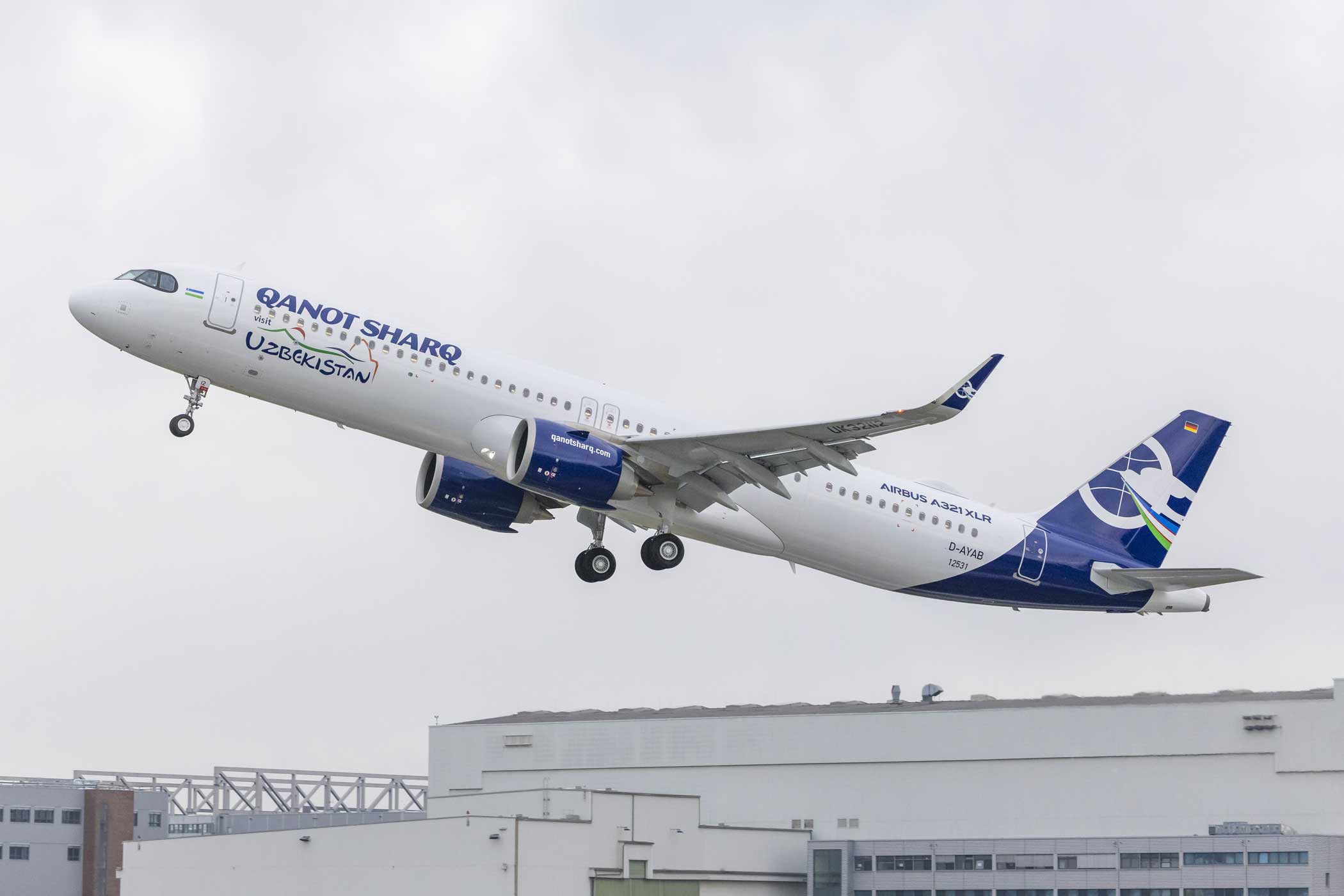
Introduction to a new era of air travel
Qanot Sharq, a leading private airline in Uzbekistan, has taken a significant step towards modernization and international expansion. With the delivery of its first A321XLR aircraft, the airline not only underscores its growth ambitions but also marks a milestone as the first operator of this modern aircraft type in Central Asia and the Commonwealth of Independent States (CIS). This event marks the beginning of a new era focused on efficiency, comfortable travel, and extended range.
The acquisition of the A321XLR is made under a long-term lease agreement with Air Lease, a renowned player in the aircraft leasing market. This investment signals a clear strategy to modernize the fleet to remain competitive and develop new international routes. The aircraft will connect key cities in Asia and overseas, significantly improving global connectivity.
Design and features of the new A321XLR
Powered by state-of-the-art CFM LEAP-1A engines, the aircraft is specifically designed to optimally combine efficiency and comfort. With a seating capacity of 190 in a two-class configuration, it offers 16 fully lie-flat seats in Business Class and 174 seats in Economy Class. This configuration is geared towards international air travelers who value a pleasant journey.
A notable feature is the Airbus Airspace cabin, equipped with XL overhead bins offering 60% more storage space than older models. Additionally, improved interior lighting creates a pleasant atmosphere and a more relaxed flight experience. Passengers can also take advantage of modern in-seat connectivity, which is particularly important for business travelers.
The generous storage options are another plus, providing greater comfort by allowing personal belongings to be stowed safely and within easy reach. This thoughtful cabin design contributes to increased passenger satisfaction and supports cabin crew by simplifying and speeding up workflows.
Technical features and ecological advantages
The A321XLR represents the most advanced evolution of the A320neo family and was specifically designed to meet the increasing market demands for range and payload. With a range of up to 4,700 nautical miles, it surpasses its predecessor, the A321LR, by approximately 15%, enabling flight routes previously only possible with larger aircraft.
Another key advantage is the significantly lower fuel consumption per seat – reduced by 30% compared to older aircraft generations. This not only leads to lower operating costs but also has a positive impact on the environment. The reduced nitrogen oxide (NOx) emissions and lower noise levels make the aircraft a sustainable partner in air transport.
Environmental aspects are further supported by the aircraft’s ability to use sustainable fuels. The A321XLR can already operate on up to 50% Sustainable Aviation Fuel (SAF). Airbus plans to achieve full compatibility with 100% SAF by 2030, which will further minimize the fleet’s environmental footprint.
Strategic importance for Qanot Sharq and regional aviation
For Qanot Sharq, the addition of the A321XLR represents a significant upgrade to its services and the opportunity to penetrate previously untapped markets. New routes, such as those to Sanya and Busan in Asia, and to New York City via Budapest, expand the network and create attractive options for passengers. This not only strengthens the airline’s market position but also fosters economic development in the region.
Furthermore, the increased range and efficiency of the A321XLR allows for better utilization of lower-demand flight routes that would be uneconomical with larger jets. This enables a more flexible route network and a better response to customer needs.
Overall, this positions the airline as a pioneer in future-oriented air transport in Central Asia and contributes to improving the region’s infrastructure and connectivity. The decision to use this modern aircraft reflects a long-term perspective where sustainability, profitability, and service quality go hand in hand.
Future outlook and sustainability
The introduction of this innovative jet is part of a broader strategy that will shape air travel for decades to come. With the A321XLR, Qanot Sharq is focusing on technological advancements that promote sustainable development while offering passengers enhanced travel experiences.
In light of global environmental challenges, reduced fuel consumption and compatibility with Sustainable Aviation Fuel are becoming increasingly important. The airline’s commitment to more environmentally friendly flight practices also positions it favorably in the face of stricter international regulations.
The aircraft’s extended range and improved technical capabilities open up new business opportunities and allow Qanot Sharq to strategically expand its route network, taking both economic and environmental aspects into account. This ensures sustainable growth that meets the increasing demand for international air transport services.
Conclusion: A milestone for the Central Asia region and the CIS countries
With the integration of the A321XLR into its fleet, Qanot Sharq is demonstrating not only its innovative strength but also a clear commitment to future-oriented, sustainable aviation. The combination of technological advancement, passenger comfort, and environmental responsibility provides a strong foundation for the company’s continued success.
The introduction of this aircraft marks a significant milestone for the Central Asian region and the CIS countries, setting new standards for modern aviation and paving the way for future international networking. It thus writes a new chapter in the history of Qanot Sharq and aviation in the region, one that meets both passenger expectations and the requirements of sustainable development.