Introduction to the Comprehensive Emergency Exercise at Hannover Airport
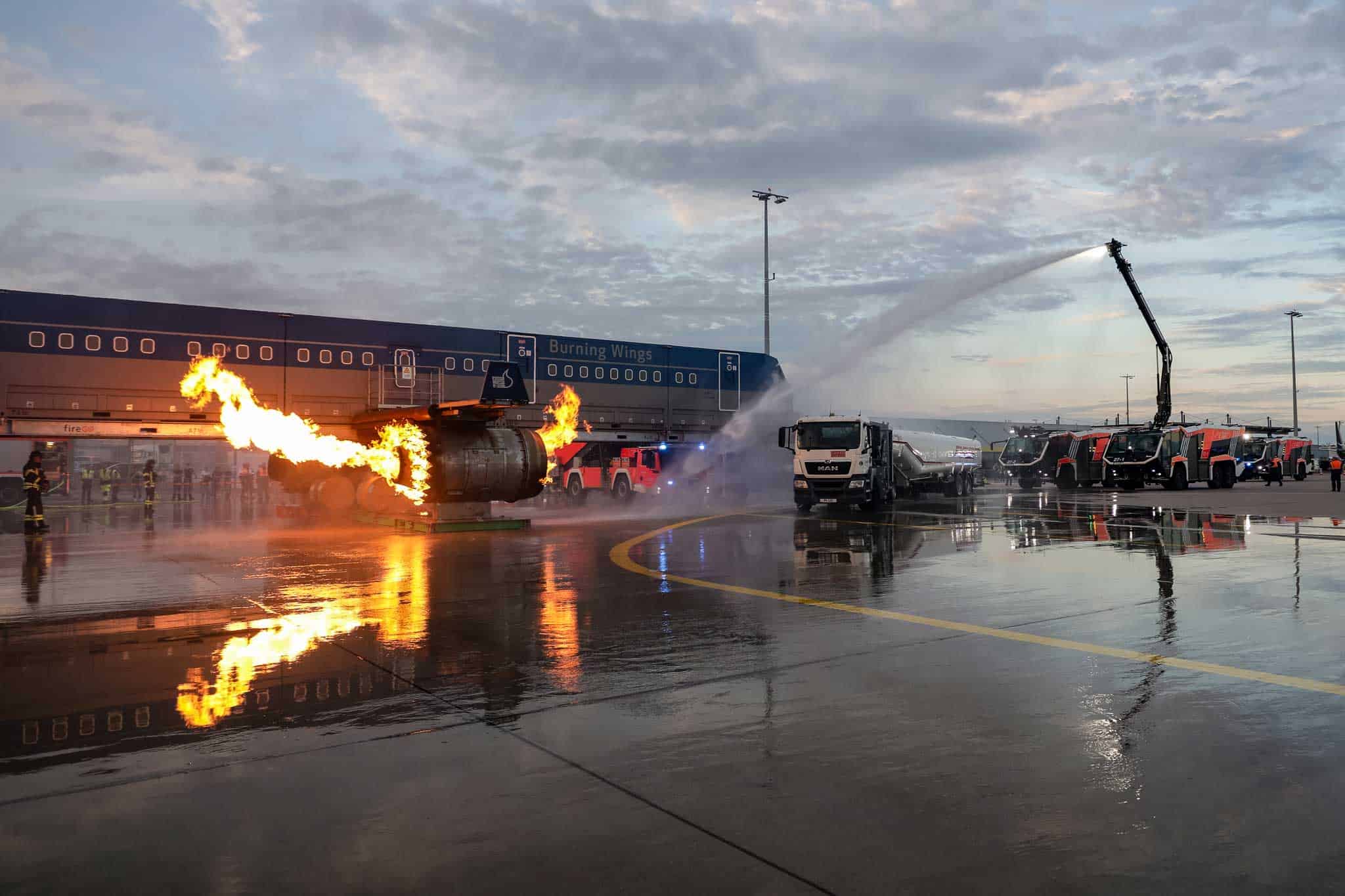
Airport safety is an essential component of air travel, making regular emergency exercises mandatory in accordance with International Civil Aviation Organization (ICAO) regulations. In September 2026, a large-scale aircraft accident exercise was conducted at Hannover Airport, involving 250 personnel from the airport fire department, municipal fire departments, and emergency medical services. The exercise aimed not only to test specific procedures but, above all, to foster coordinated cooperation among the various organizations. The focus was on rescuing people, firefighting, and providing medical care – key factors in managing crisis situations in the aviation sector.
The Exercise Scenario: A Realistic Situation on the Airfield
The simulated scenario involved a collision between a Boeing 737 and an airfield fuel tanker, resulting in significant damage to both vehicles. Leaking jet fuel ignited a secondary fire, creating a complex hazard situation. The exercise began when the German Air Traffic Control tower triggered the aircraft accident alarm. The airport fire department and other emergency services were immediately alerted and subsequently reinforced their personnel to address the incident’s classification as a mass-casualty event (MANV 20).
Joint operational coordination was carried out by the airport fire department and local volunteer fire departments from Langenhagen, Isernhagen, Burgwedel, and Wedemark, as well as the state capital, Hanover. Medical care was provided by the Hanover Region emergency medical services, including the Johanniter, the Red Cross, and the Arbeiter-Samariter-Bund. This integration of resources and expertise enabled a rapid and structured response to the complex incident.
Cooperation and challenges in managing the operation
Successfully managing such emergencies requires not only technical expertise but also close coordination among the various parties involved. Following the exercise, the airport fire department – led by Stefan Martens – drew a positive conclusion, as the collaboration with external organizations on the airport grounds had been intensively practiced and various training objectives were met. The challenge lay in ensuring a smooth operation – despite realistic time constraints and hazardous conditions – while minimizing disruption to regular flight operations.
Particular emphasis was placed on controlling the sources of the fire and rescuing passengers – roles played by trained emergency personnel and extras. The Johanniter Academy of Lower Saxony/Bremen provided a team of 70 extras to portray the injured and affected individuals within the simulated scenario. The exercise highlighted the importance of realistic accident simulations for honing the empathy and communication skills of emergency responders. Despite modern technologies such as simulation mannequins and artificial intelligence, nothing replaces training with real people when it comes to developing the competencies – involving both verbal and non-verbal communication – required during actual operations.
The RUD management’s safety team, responsible for monitoring exercise conditions, ensured that the safety of participants was maintained at all times, independent of normal flight operations. This detail underscores the high level of professionalism and depth of planning behind such large-scale exercises.
The Importance of Regular Emergency Exercises for Airport Safety
Maik Blötz, the airport’s managing director, emphasized the immense importance of such exercises. Events of this kind are essential for testing various crisis scenarios under conditions that are as realistic as possible. The challenge lies not only in the complexity of the simulated accident scenario but also in maintaining regular flight operations at the same time. Those involved must be prepared for various emergency situations to ensure a rapid and coordinated rescue response in a real emergency – which, in turn, fosters confidence among passengers and the general public.
Equally important is the evaluation of the exercise results, which takes place in the weeks following the event. A thorough analysis makes it possible to identify weaknesses and improve future response strategies. The coordination between fire and rescue services, the involvement of external organizations, and the realistic simulation of the accident scenario are elements that contribute significantly to the success of such an emergency exercise.
Conclusion: Foundations for effective hazard response at the airport
The 2026 aircraft accident exercise at Hannover Airport impressively demonstrated the complexity and demanding nature of preparing for and executing emergency measures in the aviation sector. The simulated collision with a fuel tanker, the ensuing fire, and the extensive rescue of injured persons posed a significant challenge to all responding agencies. Seamless coordination among the airport fire department, municipal fire services, emergency medical services, and other authorities was of particular importance.
The exercise demonstrated that, despite extensive technical support from simulations and virtual reality, training involving real, empathetic, and communication-trained emergency personnel cannot be replaced. Furthermore, it became clear that such exercises play a vital role in preparing the airport fire department and emergency services for real-life incidents, thereby ensuring long-term safety at Hannover Airport.
Even though regular flight operations remained unaffected by the exercise, all participants gained valuable experience that could save lives in a real emergency. Ongoing cooperation and regular exercises therefore form the foundation for professionally managing and handling emergencies on airport grounds with the utmost efficiency.