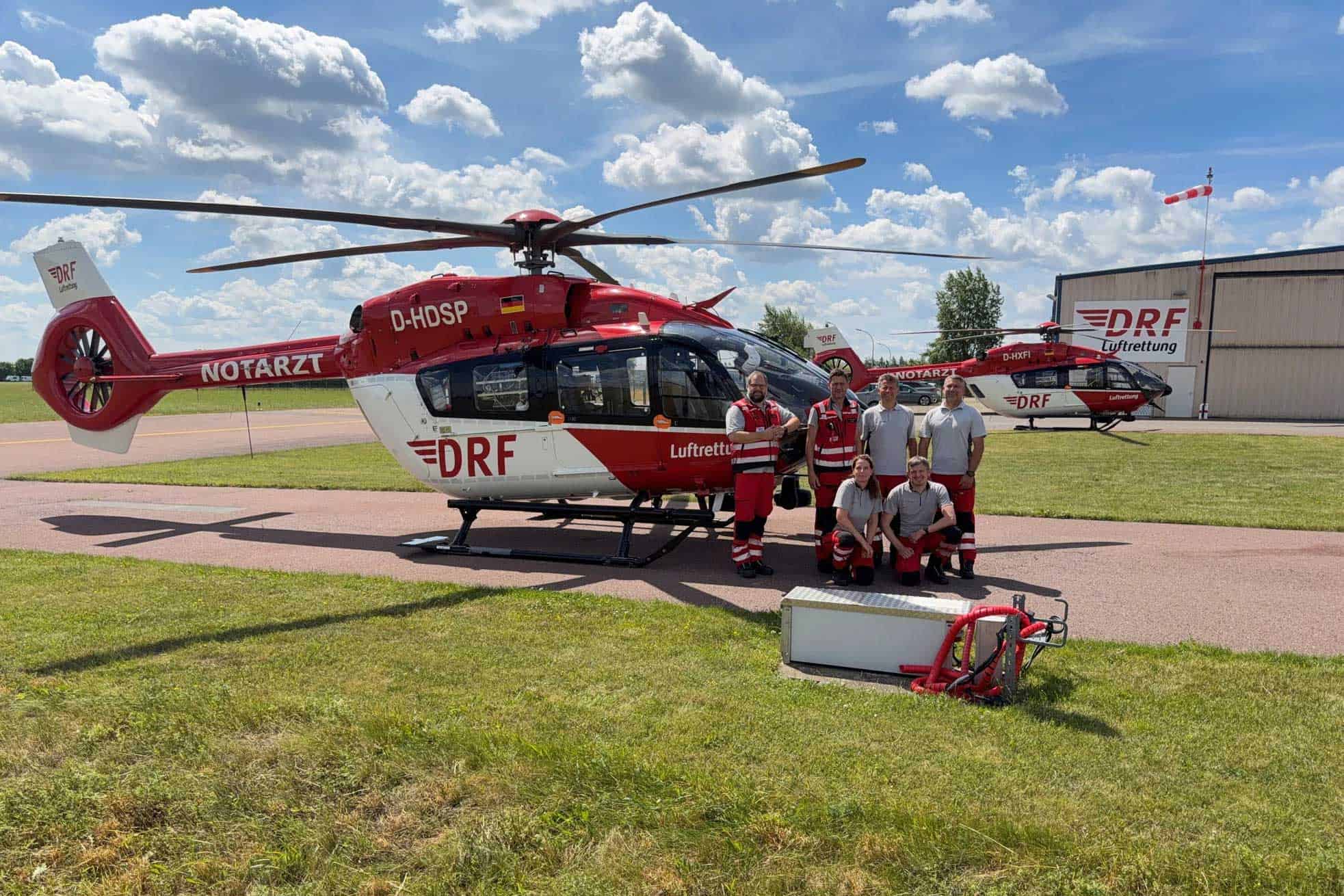
Commencement of operations at Halle-Oppin Airfield in 1991
For over three decades, air rescue services in Saxony-Anhalt have played a crucial role in the region’s emergency medical care. The air rescue base in Halle, operated by DRF Luftrettung, stands for rapid and efficient assistance from the air. Since commencing operations at Halle-Oppin Airfield in 1991, the base has continuously evolved; today, equipped with state-of-the-art technology and staffed by highly qualified crews, it provides care for patients in acute emergencies and during complex inter-hospital intensive care transports.
Historical development and potential applications
Stationary air rescue services in Saxony-Anhalt were launched with a Bell 206 LongRanger helicopter bearing the call sign “Christoph Sachsen-Anhalt.” The expansion of operations to include a Bell 222 in 1993 enabled 24-hour service for the first time, vastly improving airborne medical care. This round-the-clock operational readiness is particularly evident in nighttime rescues and intensive care transports; around one-third of all missions take place after dark, demonstrating the indispensable role of air rescue in the region.
In 2002, the stationing of a second helicopter, *Christoph Halle*, addressed the growing demand. This aircraft is on standby from the early morning hours until sunset, thereby significantly enhancing the air rescue medical services in Saxony-Anhalt. Both helicopters are specially designed for complex medical missions and feature state-of-the-art equipment.
Technical Equipment and Specialized Transport
Air rescue services in Saxony-Anhalt are distinguished by the use of state-of-the-art helicopters from Airbus Helicopters. The two five-bladed H145 helicopters now operated at both bases not only offer improved flight characteristics but also enable the transport of highly sensitive medical equipment and critically ill patients. Also noteworthy is the presence of the state’s only round-the-clock intensive care transport helicopter, which is deployed specifically for vital patient transfers between hospitals.
The air rescue crew has access to a wide range of specialized medical equipment. This includes, among other things, a mobile heart-lung machine (ECMO), which enables the highly complex care of patients suffering from severe cardiac or pulmonary conditions. The ability to operate such equipment during flight underscores the crews’ extensive medical expertise. Another key component is the use of incubators for the rapid and safe transport of premature and newborn infants with serious health issues. These specialized transports are carried out in close cooperation with the University Hospital Halle to ensure continuous, high-quality care.
Infrastructure and continuous modernization
A significant milestone was reached in December 2006 with the move into the newly constructed air rescue station and its associated hangar at Halle-Oppin Airfield. This modern facility enables more efficient organization of the helicopter fleet and optimized mission preparation. Furthermore, the recent modernization of the fleet has further enhanced the operational capabilities of air rescue services in Saxony-Anhalt. The advanced H145 helicopters, featuring a five-blade rotor system, offer superior performance and modern technology that ensure reliability and safety during operations.
The continuous renewal of the helicopter fleet and the expansion of operational capabilities reflect the high standards set for air rescue services in Saxony-Anhalt. The 2024 transition of the “Christoph Halle” service to the five-bladed H145 model represents a consistent continuation of technical advancement, enabling even more comprehensive care for the population.
Significance for emergency care and the chain of survival
Air rescue services constitute an indispensable part of the chain of survival in Saxony-Anhalt and the surrounding regions. Thanks to their high speed and flexibility, patients in life-threatening situations can be reached quickly and transported to hospitals for specialized care. This significantly reduces transfer times and increases the patients’ chances of survival.
Helicopters serve as a life-saving link, particularly in cases of severe medical emergencies or time-critical intensive care transports. Close coordination with ground-based emergency services and hospitals ensures that patients are transported seamlessly and without delay from the scene of the incident or the initial receiving hospital to the appropriate specialist center.
The availability of modern intensive care transport helicopters also ensures the highest standard of patient transfer between medical facilities. This encompasses, for example, the transport of premature infants and newborns, as well as critically ill patients requiring intensive monitoring.
Innovations and Future Prospects
Air rescue services in Saxony-Anhalt uphold the highest professional standards and continuously leverage technological advancements to further enhance the quality of care. The integration of modern aircraft and medical equipment underscores the commitment to optimal patient care, even under challenging conditions.
Future-oriented developments in air rescue could, for example, entail even closer integration between telemedicine and mission control in order to transmit specific medical expertise even more rapidly to teams on the ground. Likewise, the continuous improvement of helicopters in terms of safety, efficiency, and environmental compatibility will play a pivotal role.
Demographic change and the growing demands placed on medical care in rural areas continue to make air rescue services indispensable. Consequently, air rescue services in Saxony-Anhalt are not merely being maintained but actively developed further to meet future challenges.
Conclusion: Air rescue in Saxony-Anhalt has become indispensable.
Air rescue services in Saxony-Anhalt have become an indispensable part of the region’s emergency medical care, providing rapid, efficient, and specialized assistance from the air. A long history, continuous technological modernization, and the high level of professional expertise among the crews form the foundation for high-quality medical care in life-threatening situations.
The deployment of the two modern helicopters at the Halle base, combined with round-the-clock intensive care transport capabilities, ensures that patients receive necessary treatment as quickly as possible. Air rescue services thus successfully complement ground-based emergency services, guaranteeing seamless care throughout Saxony-Anhalt – and beyond.
Future challenges will be met through innovation and investment in modern technology to ensure continued first-class care. In this way, air rescue remains an essential component of the region’s healthcare and emergency response system, making an unparalleled contribution to the safety and health of the population.