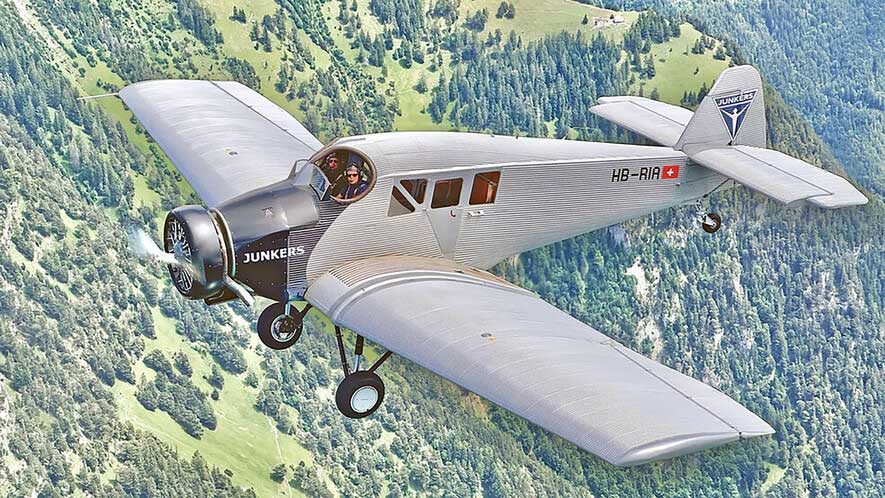
Flying like 100 years ago at the airfield festival of the Mainz Aviation Club (Luftfahrtverein Mainz e. V.).
From September 4 to 6, 2026, near-exact replicas of the Junkers F13 will visit the airfield in Finthen for the Mainz Aviation Club’s airfield festival. Plans include sightseeing flights in this legendary aircraft. According to the organizers, participation is open only to those who become club members in advance. Depending on weather conditions and booking levels, two aircraft are scheduled to take off simultaneously, offering aerial views of Mainz and the Rhine Valley. Anyone wishing to fly must become a club member well ahead of time.
A rare opportunity for aviation enthusiasts
While the historic aircraft’s exterior is reminiscent of the pioneering era of civil aviation, its technical specifications meet modern safety standards. The scheduled flights in Rhineland-Palatinate are part of a tour organized for 2026 by the Altenrhein-based association Junkers Luftverkehr. The focus is on an aircraft model regarded as a milestone in early passenger aviation.
Why the Junkers F13 is considered an icon to this day
The Junkers F13 made its maiden flight in Dessau in 1919 and is considered the world’s first all-metal passenger aircraft made of duralumin. The Deutsches Museum in Munich classifies the type as follows: “The F13 was the first passenger aircraft made of metal – a world first in June 1919.”
Featuring an open cockpit for the pilot and flight mechanic or co-pilot, as well as an enclosed cabin for four passengers, this low-wing aircraft was used as a passenger and cargo plane in the 1920s. Due to this layout, aviation historians sometimes refer to it as a “stagecoach of the skies.”
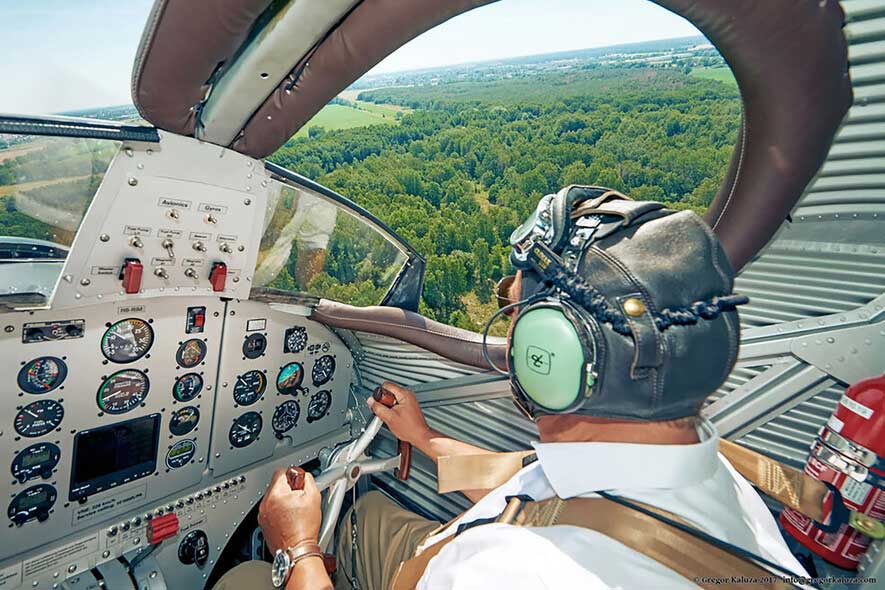
Original machines survive today only as museum pieces. There are no longer any airworthy vintage aircraft of this type.
Post-war period
Most of the original aircraft disappeared from scheduled service by the Second World War at the latest. Individual examples continued to fly in remote regions until the early post-war period.
Today
According to the “Junkers Luftverkehr” association, based in Altenrhein (Switzerland), three F13 replicas are in operation: HB-RIM (2016/2018), HB-RIA (2022), and HB-RIO (2023). The years listed after the registration marks refer to the maiden flight and/or official flight authorizations. The HB-RIM replica also operated in the USA for a time, flying there under the registration N13JU.
On the outside, almost just like back then; on the inside, modern aviation technology.
Externally, the replicas closely follow the original design, featuring the distinctive corrugated duralumin skin and the period-accurate appointments of the small passenger cabin.
However, up-to-date systems are at work on board: modern avionics are used in the cockpit to meet current safety requirements. The aircraft is powered by a modern radial engine.
The replica, measuring approximately ten meters in length with a wingspan of just under 15 meters, is designed to accommodate two crew members in a semi-open cockpit and four passengers in an enclosed, heated cabin. However, according to the association, a maximum of three passengers are carried on the sightseeing flights offered, due to weight considerations.
How the booking works – and what interested parties need to know
“We view the F13 as a piece of flying cultural heritage, significant to both aviation technology and the history of transport,” says association chairman Bernd Huckenbeck. “For many guests, a sightseeing flight is a brief journey back in time to the early days of passenger aviation. It is a truly special experience.”
According to the association, membership is required for flights due to aviation regulations. There must be a lead time of at least 30 days between joining and the flight date. Consequently, bookings are made exclusively via the website. The number of seats is limited.
The association provides specific information online at https://junkers-luftverkehr.com.

The History of the Junkers F13 and Its Replicas: Historical Highlights
1919: Under the direction of Professor Hugo Junkers, the Junkers F13 is developed; it is considered the first all-metal commercial aircraft. Instead of wood and fabric, the engineer opts for corrugated sheet metal made from a lightweight aluminum alloy.
Unusual for the time is the configuration: an open cockpit at the front for the pilot and flight mechanic, followed by an enclosed, heated cabin for four passengers. The Junkers F13 is therefore also known as the “stagecoach of the skies.”
June 25, 1919: The Junkers F13 takes off from Dessau (Saxony-Anhalt) for its official maiden flight. – The Deutsches Museum in Munich assesses it in retrospect as follows: “The F13 was the first all-metal passenger aircraft – a world first in June 1919.”
September 13, 1919: A high-altitude flight by a Junkers F13 carrying seven people to an altitude of over 6,700 meters is recorded as a record-breaking flight. Accounts describe it as a world altitude record.
1921–1926: Junkers expands its air transport operations. Junkers Luftverkehr AG is considered a key precursor to later scheduled airlines. On January 6, 1926, Junkers Luftverkehr AG and Deutsche Aero Lloyd AG are merged under government pressure. This results in the creation of Deutsche Luft Hansa Aktiengesellschaft – spelled this way until 1931 – as a state-owned enterprise and a precursor to today’s Deutsche Lufthansa AG.
Mid-1920s: The F13 helps shape early civil aviation. It is deployed worldwide and built in numbers well exceeding 300 – a high production figure for that era.
1930s: The Junkers Ju 52 (“Aunt Ju”) marked the arrival of the next generation of scheduled airliners, boasting significantly higher passenger capacity. Historically, the Junkers F13 is considered its predecessor; both models exemplify the Junkers design philosophy, characterized by all-metal construction and a distinctive corrugated metal skin.
2013: The replica project is relaunched and put into practice. The initiator and financier is Cologne-based entrepreneur and pilot Dieter Morszeck, the long-time head of Rimowa. Visual representations draw a connection between the ribbed design of Rimowa aluminum suitcases and the outer skin of the Junkers aircraft.
September 15, 2016: Official maiden flight of the first Junkers F13 replica (a near-exact reproduction) in Dübendorf, Switzerland – almost 100 years after the original took to the skies.
2026: Planned stops and sightseeing flights for the Junkers F13 in 2026 include Altenrhein in Switzerland, as well as the following locations in Germany: Gelnhausen, Kempten-Durach, Leverkusen (Kurtekotten), Mainz-Finthen, and Oberschleißheim (Flugwerft Schleißheim).