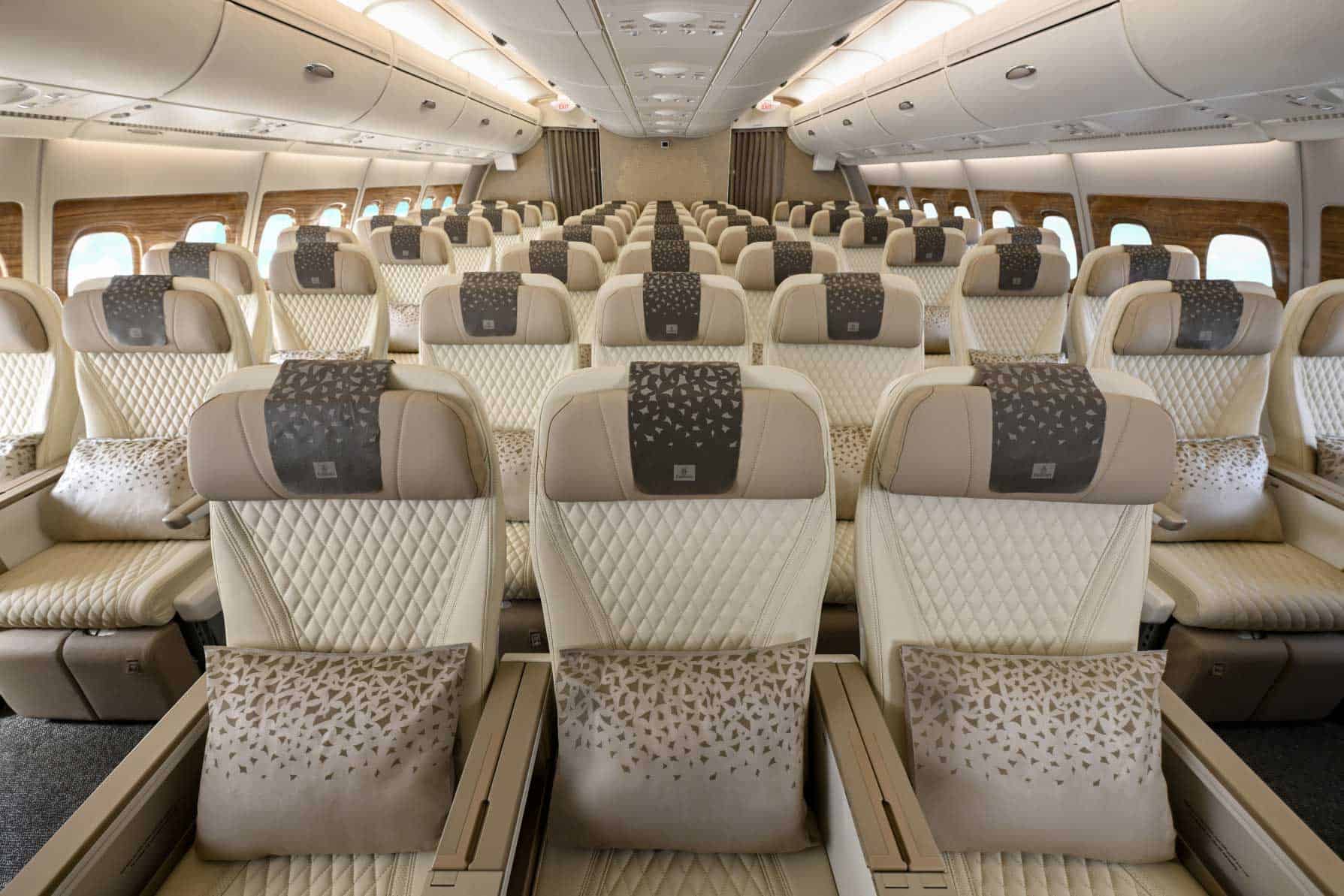
Integration of Premium Economy Class on the upper deck of the superjumbos
The rapid evolution of the aviation industry demands continuous innovation from airlines to meet the needs of diverse passenger segments. Emirates is taking a significant step forward in aircraft modernization with the conversion of its first A380 – formerly configured with two cabin classes – into a three-class configuration. This initiative is part of the airline’s comprehensive retrofit program, which aims to sustainably enhance the travel experience while ensuring efficient resource utilization. The integration of a Premium Economy Class on the upper deck of these superjumbos marks a notable fleet first and underscores Emirates’ commitment to offering high-quality cabin concepts that prioritize passenger comfort. The following text explores the technical and design aspects of this conversion, its strategic significance for the fleet, and the consistent implementation of sustainability measures.
Re-evaluation of Cabin Interiors in the A380 Fleet
The centerpiece of Emirates’ retrofit project is the reconfiguration of the cabin layout. The modification of the A380 registered as A6-EUX marks the first conversion from a two-class to a three-class configuration. The new interior now features 76 Business Class seats, 56 Premium Economy seats, and 437 Economy Class seats. This finer segmentation facilitates the customization of product offerings and addresses diverse travel needs. Crucial to the implementation was the removal of 120 Economy Class seats on the upper deck to accommodate the installation of spacious Premium Economy seats in a 2-3-2 arrangement. As a result, the travel experience undergoes a qualitative enhancement, as the positioning of Premium Economy on the upper deck ensures greater privacy and comfort.
The integration of modern seating models—featuring variable recline, ergonomically designed headrests and footrests, and integrated USB ports – underscores the focus on comfort. This is complemented by an extensive in-flight entertainment system featuring high-resolution screens that showcase the innovative Emirates *ice* system. The balanced color palettes and the incorporation of the Ghaf tree motif into the design and furnishings contribute to creating an atmosphere that is both harmonious and luxurious.
Extensive Technical Challenges and Precise Implementation
The technical modernization necessitated a detailed planning and implementation process. The complete dismantling of all interior elements made it possible to fundamentally rethink the cabin layout. In addition to relocating and upgrading the cabin furnishings, the galley components, overhead bins, and partition walls had to be adapted. Furthermore, extensive modifications were required to the electrical and sanitary systems to accommodate the new loads and functional requirements.
The team of approximately 50 engineers and technicians invested nearly 35,000 man-hours, utilizing more than 2,500 individual components in the process. The coordination and optimization of the assembly processes enabled the completion of the first retrofitted aircraft within just two months—a feat that underscores the expertise and efficiency of Emirates Engineering. For subsequent retrofits, the aim is to halve the required time, ensuring that all 15 two-class A380s will be modernized by the end of 2026.
This transition presents both a logistical and a technological challenge, as it is necessary to adhere to high standards of airworthiness and passenger safety. Extensive testing series and close collaboration with suppliers ensure that all modifications comply with regulatory requirements and offer a high degree of reliability.
Strategic Further Development of the Emirates Retrofit Program
The retrofit program was launched in 2021 to systematically modernize the fleet and provide a consistent, high-quality travel experience. Initially, 120 aircraft were slated for retrofitting; with the expansion in 2024, the project now encompasses 219 aircraft, including Airbus A380 and Boeing 777 models. The accompanying increase in capacity and improvement in cabin quality are part of a strategic alignment aimed at consolidating the company’s market position and responding to evolving passenger needs.
The cabin reconfiguration also facilitates the differentiation of services and supports adaptation to various price segments – particularly through the newly introduced Premium Economy class. This offers an attractive middle ground between Business and Economy Class, catering to a growing customer segment that seeks to combine comfort and quality with moderate costs.
Approximately 270 employees are currently active in this program, ensuring the smooth execution of assembly work and the timely handover of the modernized aircraft. Throughout this process, material procurement is regularly optimized, and procedures are adapted based on the experience gained during the retrofit, in order to efficiently scale the conversion operations.
Sustainability and Social Commitment through Innovative Upcycling
Emirates is also placing increased emphasis on responsible consumption as part of its comprehensive retrofit program. Instead of simply disposing of materials, components from the cabins are recycled and repurposed into high-quality products. This upcycling concept enabled, for instance, the creation of the “Aircrafted” product line – a collection featuring limited-edition collectibles such as luggage and accessories.
Particular emphasis is also placed on supporting social projects. For instance, the “Aircrafted for Kids” program produced sustainable backpacks crafted from the fabric of former Economy Class seats – items that have since been distributed to over 4,000 children across ten different countries. This initiative serves as a prime example of integrating environmental and social responsibility within the context of aircraft modernization, offering a sustainable alternative to conventional material disposal.
Through these initiatives, Emirates succeeds not only in reducing its environmental impact but also in creating social value and strengthening customer loyalty through sustainable values.
Conclusion: Expansion of the retrofit program to over 200 aircraft.
The reconfiguration of the first Emirates A380 into a three-class cabin configuration marks a significant milestone in the airline’s retrofit program. The technical and design complexity of this conversion demonstrates the team’s ability to combine innovation with efficiency. The integration of the Premium Economy Class on the upper deck of the A380 not only represents an enhancement of inflight comfort but also contributes to meeting the growing demand for versatile travel options.
With the expansion of its retrofit program to over 200 aircraft, Emirates demonstrates how consistent investment in modernization and the customer experience can foster long-term success. At the same time, the sustainable use of resources remains a central element, linking social responsibility with environmental protection through upcycling projects.
This holistic approach to aircraft modernization sets new industry standards and offers passengers worldwide a forward-looking, comfortable, and – at the same time – responsible travel experience. In doing so, Emirates promotes not only advancements in aircraft technology and design but also the responsible use of finite resources.
The planned completion of the retrofit of all 15 two-class A380s by the end of 2026 promises another significant step for global air travel, underscoring the dynamic evolution of premium cabins and the relevance of innovative retrofit measures for the future of aviation.