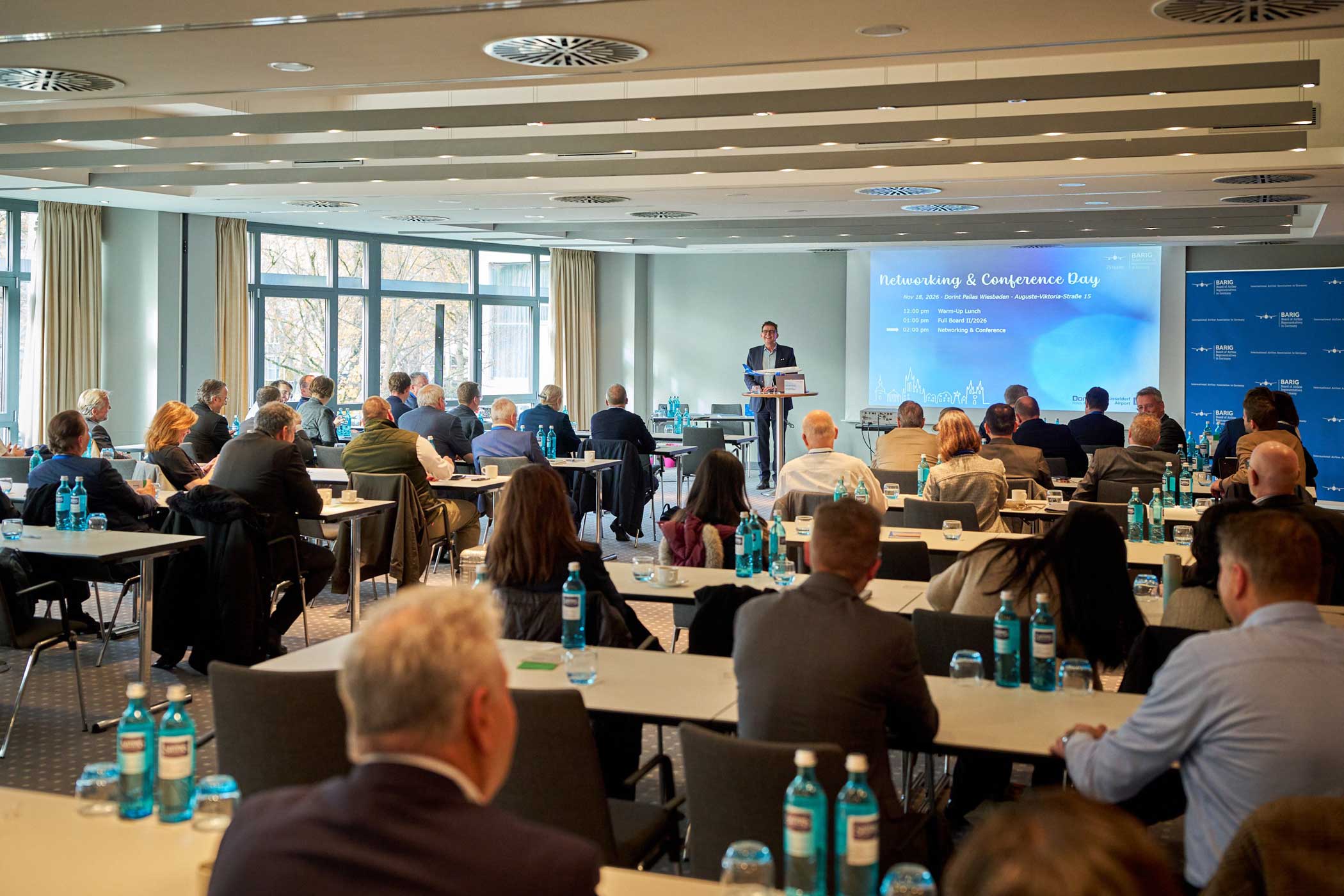
At the BARIG Networking & Conference Day in Wiesbaden, around 100 representatives from the aviation sector, the business community, and politics discussed the future of Germany as a hub for air transport. The industry’s consensus is clear: without tangible reductions in state-imposed location costs, Germany risks falling further behind in international competition.
While global air traffic has long since surpassed pre-crisis levels, Germany is currently reaching only about 85 percent of its former volume. According to participants at a conference organized by the international airline association BARIG (Board of Airline Representatives in Germany), the recovery is being held back primarily by high government levies, fees, and a complex regulatory environment.
Policymakers and airlines call for a reliable regulatory framework
In light of current market conditions, BARIG head Michael Hoppe urged for swift political decisions: “Given an environment marked by numerous challenges, we need rapid, collaborative solutions to sustainably strengthen the international competitiveness of Germany as a hub for air transport.”
Support from the political sphere came from the Hessian Minister of Finance and Chairman of the Fraport Supervisory Board, Prof. Dr. R. Alexander Lorz: “A high-performing aviation sector is a key factor for Germany’s competitiveness as a business location and for its global connectivity. To achieve this, we need efficient processes, reliable framework conditions, and an ongoing dialogue between policymakers and the industry.”
Air freight as the backbone of resilient supply chains
In addition to passenger transport, air freight – a sector currently facing significant challenges due to geopolitical tensions and shifting trade flows – was a key focus of the discussions. In his keynote address, Timo Stroh, chair of the Air Freight Forwarding Committee at the German Freight Forwarding and Logistics Association (DSLV), highlighted the sector’s vital role in the broader economy: “Air freight is far more than just the transport of goods. It connects international markets, secures industrial value creation, and serves as a crucial component of resilient supply chains.”
According to Stroh, securing Germany’s long-term position as a logistics and air transport hub requires, above all, high-performing airports, modern infrastructure, and reliable handling processes.