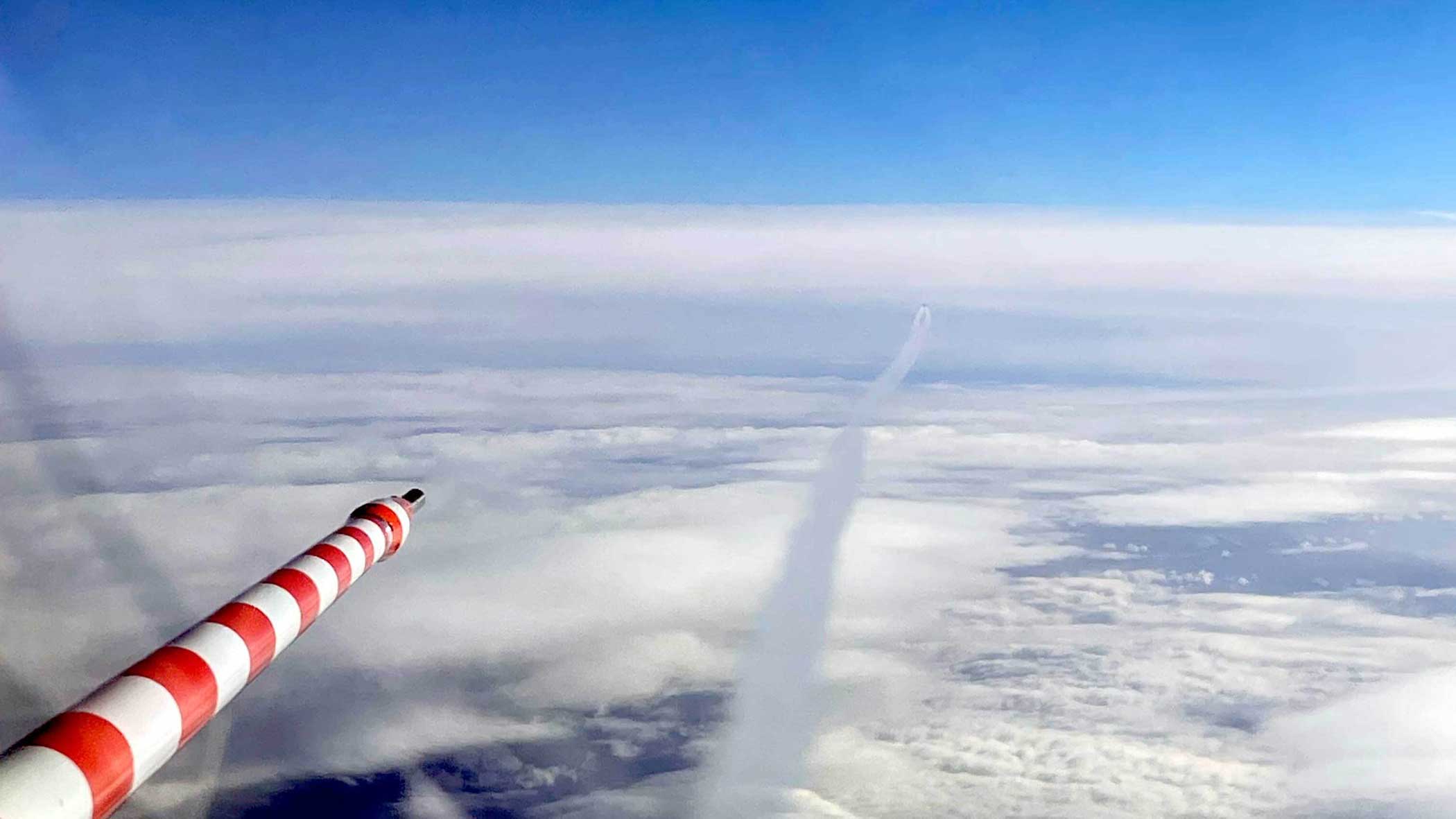
Europe is taking an important step towards climate-friendly aviation: The A4CLIMATE project brings together researchers and industry partners to determine how contrails can be effectively avoided – and how much their climate impact can actually be reduced. Led by the German Aerospace Center (DLR), A4CLIMATE involves 17 project partners from nine countries working to reduce the formation and climate impact of contrails – through intelligent flight routes, innovative engine technology, and alternative fuels.
The researchers are combining satellite data, aircraft and ground measurements, modern climate models, and a new contrail prediction system. A total of 400 scheduled flights, ideally those that produce no contrails, will be examined over the course of the project. Currently, the German Aerospace Center (DLR) is also conducting measurement flights with its Falcon 20E research aircraft, which is specifically following TUIfly airliners during contrail observation flights over Germany and Austria.
Surprising challenges
To test the effectiveness of the measures under real-world conditions, the DLR is conducting specific measurement flights together with the German airline TUIfly and the Austrian aviation company FLIGHTKEYS. The principle is simple: whenever possible, flights are conducted outside of regions where contrails form.
However, practice shows how complex this can become. Delays or changes in weather make it difficult to adhere precisely to the ideally planned routes. And sometimes an alternative route also means a few more flight kilometers – and thus more carbon dioxide (CO2) emissions. The challenge here is to develop and test robust processes and solutions under these constraints.
The project team is working on a fully automated data pipeline that provides real-time route recommendations and immediate feedback on whether a flight can be planned in a more climate-friendly way. Satellites will later verify whether the strategy actually produces fewer contrails in reality. The net climate impact will also be calculated using models.

Modern engines and sustainable fuels
In addition to flight planning, A4CLIMATE investigates how new engines and alternative fuels
To test this, the DLR research aircraft Falcon 20E is currently accompanying TUIfly passenger planes equipped with innovative, low-soot lean-burn engines. The flights deliberately take place in regions that favor contrail formation. This allows for direct measurements in the atmosphere, under real-world conditions, of the properties of the contrails produced by these new engines: “We want to understand how much climate change can be reduced if aircraft are more modern and intelligent,” explains project manager Prof. Christiane Voigt from the DLR Institute of Atmospheric Physics.
For the approximately two-week flight tests, typical travel routes from Germany to Egypt are being used. The Falcon 20E, operated by the DLR Flight Experiments facility in Oberpfaffenhofen, flies about ten kilometers behind selected TUIfly flights. The team measures the resulting contrails using high-precision instrumentation. Researchers from the DLR Institute of Atmospheric Physics are investigating, in particular, how soot and volatile particles in the exhaust plume change over a period of up to 30 minutes and how they influence the contrails. The measurement data will be used to further improve model simulations of engines and contrails and to refine weather forecasts.
Climate-friendly flying – but realistically
Contrails form at high altitudes when hot exhaust gases meet very cold, moist air. These inconspicuous lines in the sky transform into ice clouds that trap heat in the atmosphere and contribute to global warming. Their climate impact is comparable to that of all CO2 emissions from air traffic. The EU is therefore striving for the systematic monitoring of these non-CO2 effects.
A4CLIMATE thus provides, for the first time, comprehensive data on how contrails can be avoided, reduced, and made more climate-friendly. The project aims to create a scientific basis for new EU regulations and provide airlines with practical tools.
One thing is clear: the
| Background information: Climate-optimized flight routes |
|---|
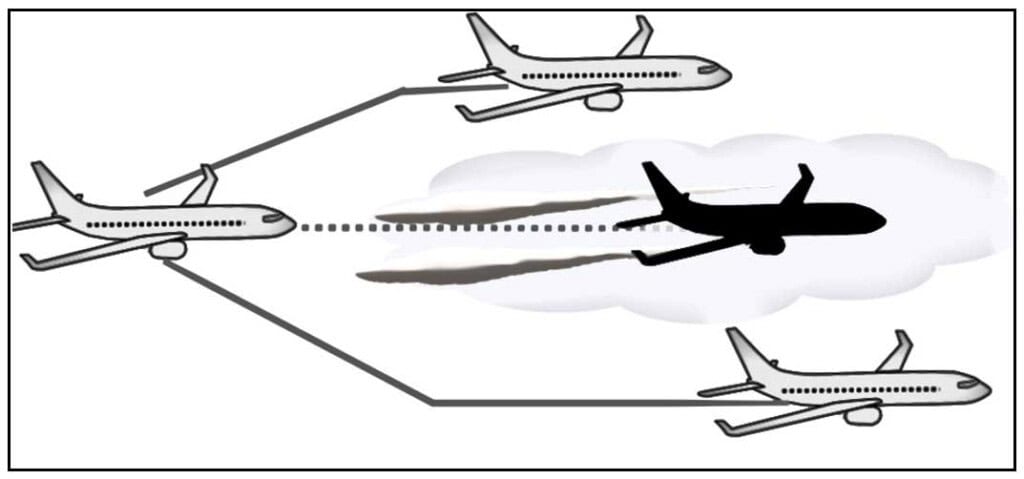
| Testing climate-optimized flight trajectories is a crucial step in demonstrating the economic feasibility of this approach. This involves deliberately avoiding airspace with particularly high warming caused by contrails. Such adjustments lead to changes in the optimal flight altitude, potentially resulting in longer flight times, higher fuel consumption, and slightly increased CO2 emissions. The DLR Institute of Atmospheric Physics compares the climate impact of these additional emissions with the reduced non-CO2 effects to estimate the overall climate impact. The results are also verified using satellite data, taking existing uncertainties into account. Through targeted research, DLR supports the practical implementation of climate-optimized flight routes. At the DLR Institute of Air Transport, researchers simultaneously analyze the operational and economic impacts for airlines to develop recommendations for action, such as potential financial incentives. |